
I need to write the reverse (encryption) of the following decryption function:
const crypto = require('crypto');

let AESDecrypt = (data, key) => {
  const decoded = Buffer.from(data, 'binary');

  const nonce = decoded.slice(0, 16);
  const ciphertext = decoded.slice(16, decoded.length - 16);
  const tag = decoded.slice(decoded.length - 16);

  let decipher = crypto.createDecipheriv('aes-256-gcm', key, nonce);
  decipher.setAuthTag(tag)
  decipher.setAutoPadding(false);
  try {
    let plaintext = decipher.update(ciphertext, 'binary', 'binary');
    plaintext += decipher.final('binary');
    return Buffer.from(plaintext, 'binary');
  } catch (ex) {
    console.log('AES Decrypt Failed. Exception: ', ex);
    throw ex;
  }
}
This above function allows me to properly decrypt encrypted buffers following the spec:
| Nonce/IV (First 16 bytes) | Ciphertext | Authentication Tag (Last 16 bytes) |
The reason why AESDecrypt is written the way it (auth tag as the last 16 bytes) is because that is how the default standard library implementations of AES encrypts data in both Java and Go. I need to be able to bidirectionally decrypt/encrypt between Go, Java, and Node.js. The crypto library based encryption in Node.js does not put the auth tag anywhere, and it is left to the developer how they want to store it to pass to setAuthTag() during decryption. In the above code, I am baking the tag directly into the final encrypted buffer.
So the AES Encryption function I wrote needed to meet the above circumstances (without having to modify AESDecrypt since it is working properly) and I have the following code which is not working for me:
let AESEncrypt = (data, key) => {

  const nonce = 'BfVsfgErXsbfiA00'; // Do not copy paste this line in production code (https://crypto.stackexchange.com/questions/26790/how-bad-it-is-using-the-same-iv-twice-with-aes-gcm)
  const encoded = Buffer.from(data, 'binary');

  const cipher = crypto.createCipheriv('aes-256-gcm', key, nonce);
  try {
    let encrypted = nonce;
    encrypted += cipher.update(encoded, 'binary', 'binary')
    encrypted += cipher.final('binary');
    const tag = cipher.getAuthTag();
    encrypted += tag;
    return Buffer.from(encrypted, 'binary');
  } catch (ex) {
    console.log('AES Encrypt Failed. Exception: ', ex);
    throw ex;
  }
}
I am aware hardcoding the nonce is insecure. I have it this way to make it easier to compare properly encrypted files with my broken implementation using a binary file diff program like vbindiff
The more I looked at this in different ways, the more confounding this problem has become for me.
I am actually quite used to implementing 256-bit AES GCM based encryption/decryption, and have properly working implementations in Go and Java. Furthermore, because of certain circumstances, I had a working implementation of AES decryption in Node.js months ago.
I know this to be true because I can decrypt in Node.js, files that I encrypted in Java and Go. I put up a quick repository that contains the source code implementations of a Go server written just for this purpose and the broken Node.js code.
For easy access for people that understand Node.js, but not Go, I put up the following Go server web interface for encrypting and decrypting using the above algorithm hosted at https://go-aes.voiceit.io/. You can confirm my Node.js decrypt function works just fine by encrypting a file of your choice at https://go-aes.voiceit.io/, and decrypting the file using decrypt.js (Please look at the README for more information on how to run this if you need to confirm this works properly.)
Furthermore, I know this issue is specifically with the following lines of AESEncrypt:
    const tag = cipher.getAuthTag();
    encrypted += tag;
Running vbindiff against the same file encrypted in Go and Node.js, The files started showing differences only in the last 16 bytes (where the auth tag get's written). In other words, the nonce and the encrypted payload is identical in Go and Node.js.
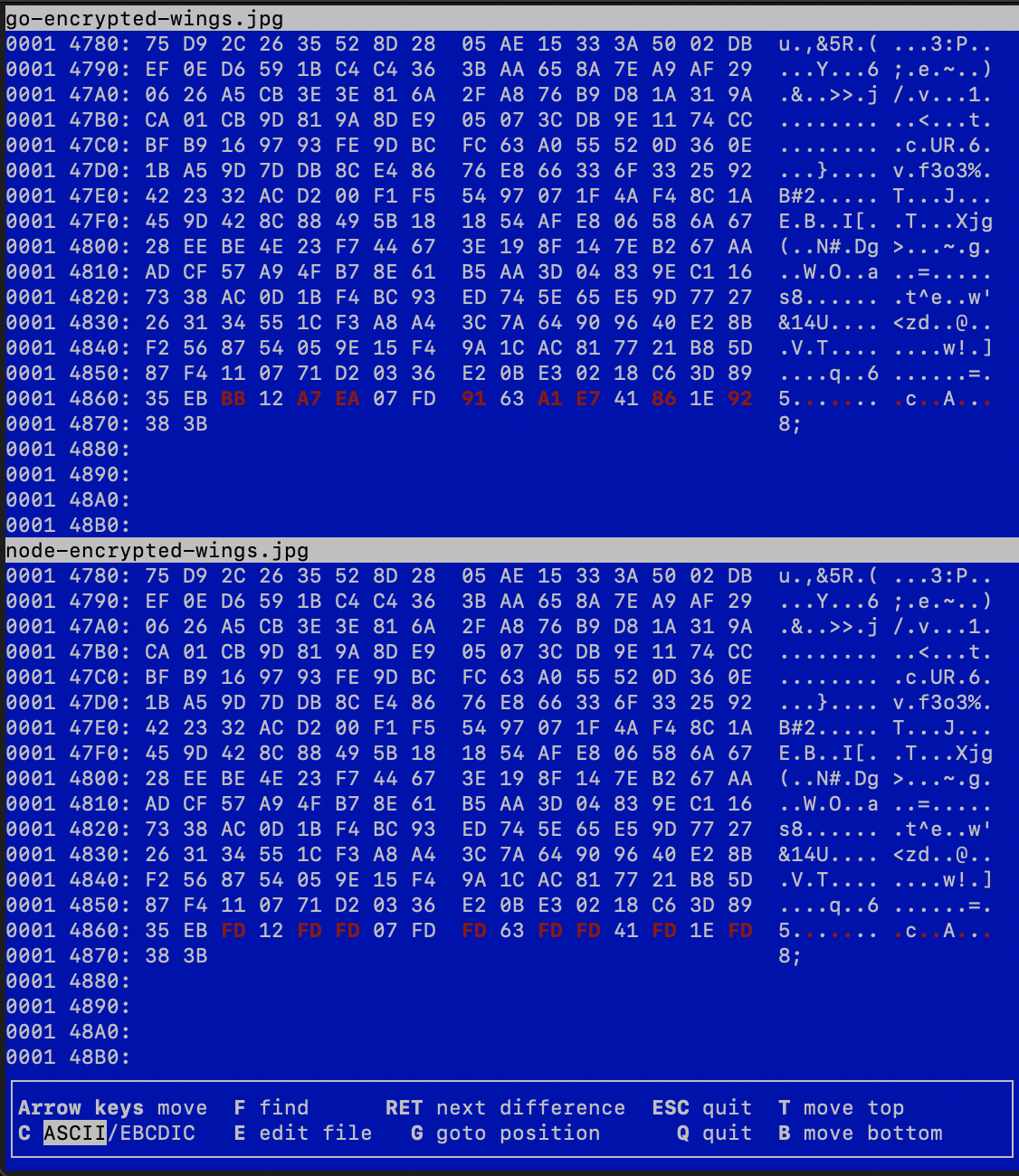
Since the getAuthTag() is so simple, and I believe I am using it correctly, I have no idea what I could even change at this point. Hence, I have also considered the remote possibility that this is a bug in the standard library. However, I figured I'd try Stackoverflow first before posting an Github Issue as its most likely something I'm doing wrong.
I have a slightly more expanded description of the code, and proof of how I know what is working works, in the repo I set up to try to get help o solve this problem.
Thank you in advance.
Further info: Node: v14.15.4 Go: go version go1.15.6 darwin/amd64