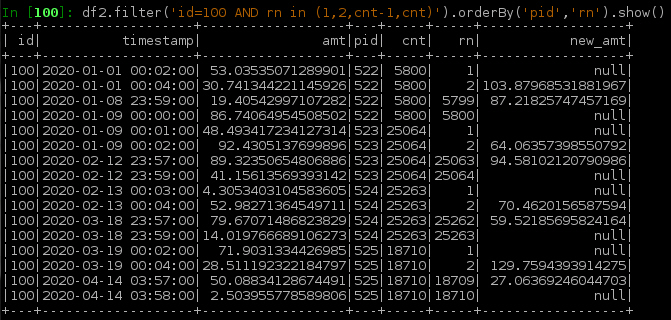
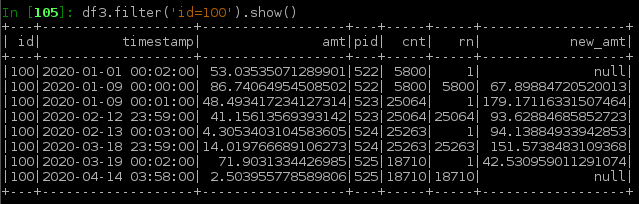
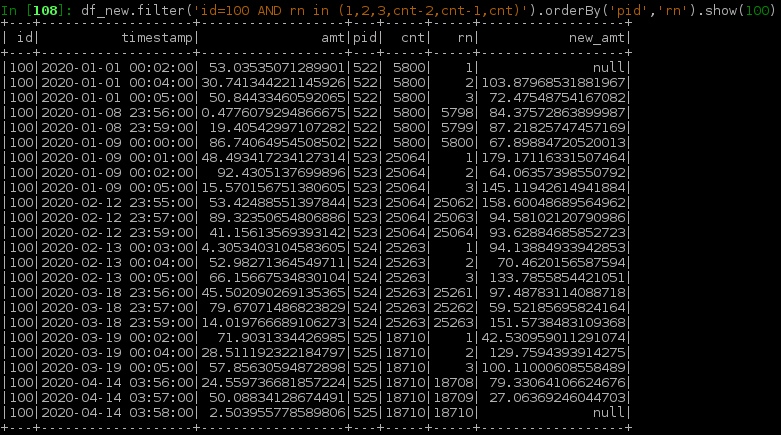
I have a huge PySpark dataframe and I'm doing a series of Window functions over partitions defined by my key.
The issue with the key is, my partitions gets skewed by this and results in Event Timeline that looks something like this,
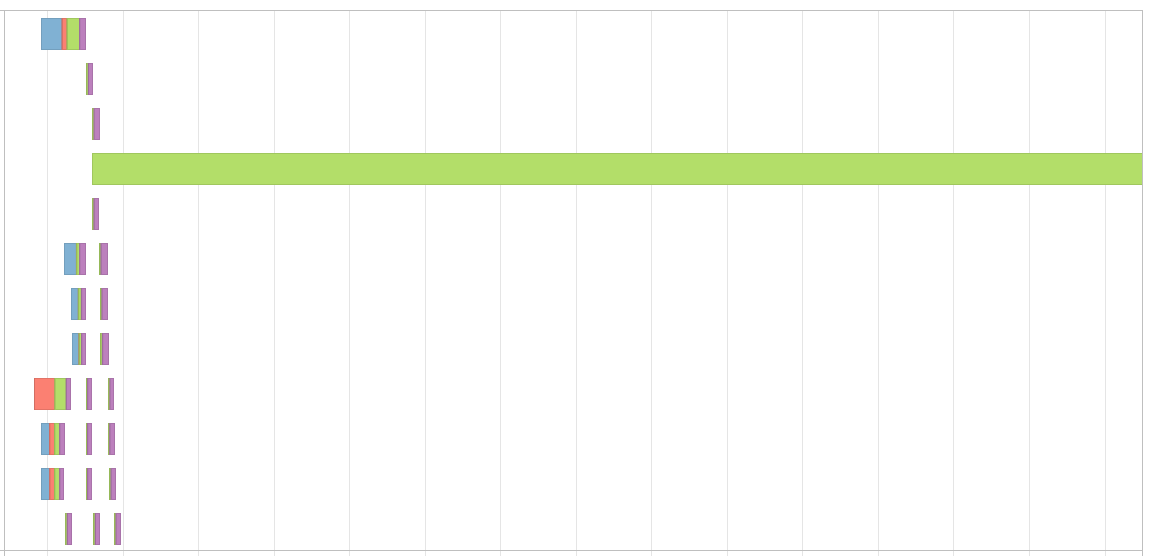
I know that I can use salting technique to solve this issue when I'm doing a join. But how can I solve this issue when I'm using Window functions?
I'm using functions like lag, lead etc in the Window functions. I can't do the process with salted key, because I'll get wrong results.
How to solve skewness in this case?
I'm looking for a dynamic way of repartitioning my dataframe without skewness.
Updates based on answer from @jxc
I tried creating a sample df and tried running code over that,
df = pd.DataFrame()
df['id'] = np.random.randint(1, 1000, size=150000)
df['id'] = df['id'].map(lambda x: 100 if x % 2 == 0 else x)
df['timestamp'] = pd.date_range(start=pd.Timestamp('2020-01-01'), periods=len(df), freq='60s')
sdf = sc.createDataFrame(df)
sdf = sdf.withColumn("amt", F.rand()*100)
w = Window.partitionBy("id").orderBy("timestamp")

sdf = sdf.withColumn("new_col", F.lag("amt").over(w) + F.lead("amt").over(w))
x = sdf.toPandas()
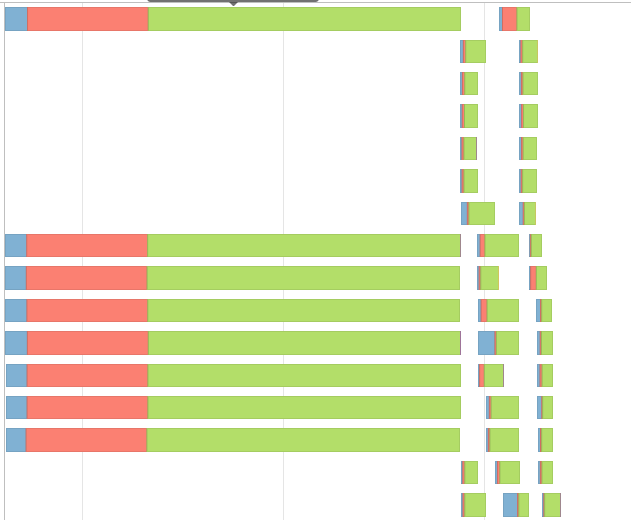
This gave me a event timeline like this,
I tried the code from @jxc's answer,
sdf = sc.createDataFrame(df)
sdf = sdf.withColumn("amt", F.rand()*100)

N = 24*3600*365*2
sdf_1 = sdf.withColumn('pid', F.ceil(F.unix_timestamp('timestamp')/N))

w1 = Window.partitionBy('id', 'pid').orderBy('timestamp')
w2 = Window.partitionBy('id', 'pid')

sdf_2 = sdf_1.select(
    '*',
    F.count('*').over(w2).alias('cnt'),
    F.row_number().over(w1).alias('rn'),
    (F.lag('amt',1).over(w1) + F.lead('amt',1).over(w1)).alias('new_val')
)

sdf_3 = sdf_2.filter('rn in (1, 2, cnt-1, cnt)') \
    .withColumn('new_val', F.lag('amt',1).over(w) + F.lead('amt',1).over(w)) \
    .filter('rn in (1,cnt)')

df_new = sdf_2.filter('rn not in (1,cnt)').union(sdf_3)

x = df_new.toPandas()
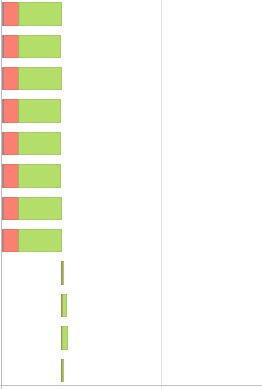
I ended up one additional stage and the event timeline looked more skewed,
Also the run time is increased by a bit with new code