
I am trying to train a convolutional neural network but I get a quite high number of false positive classified objects. I am using two classes, each 10.000 images with quite obvious differences. I would expect a rather easy task for a CNN, also I used some hand crafted features with a random forest classifier before which worked quite well.
This is the model I am using:
    def build(width, height, depth, classes):
        model = Sequential()
        inputShape = (height, width, depth)
        chanDim = -1
        # if we are using "channels first", update the input shape
        # and channels dimension
        if K.image_data_format() == "channels_first":
            inputShape = (depth, height, width)
            chanDim = 1

        # CONV => RELU => POOL layer set
        model.add(Conv2D(32, (3, 3), padding="same",
                         input_shape=inputShape))
        model.add(Activation("relu"))
        model.add(BatchNormalization(axis=chanDim))
        model.add(MaxPooling2D(pool_size=(2, 2)))
        model.add(Dropout(0.25))

        # (CONV => RELU) * 2 => POOL layer set
        model.add(Conv2D(64, (3, 3), padding="same"))
        model.add(Activation("relu"))
        model.add(BatchNormalization(axis=chanDim))
        model.add(Conv2D(64, (3, 3), padding="same"))
        model.add(Activation("relu"))
        model.add(BatchNormalization(axis=chanDim))
        model.add(MaxPooling2D(pool_size=(2, 2)))
        model.add(Dropout(0.25))

        # (CONV => RELU) * 3 => POOL layer set
        model.add(Conv2D(128, (3, 3), padding="same"))
        model.add(Activation("relu"))
        model.add(BatchNormalization(axis=chanDim))
        model.add(Conv2D(128, (3, 3), padding="same"))
        model.add(Activation("relu"))
        model.add(BatchNormalization(axis=chanDim))
        model.add(Conv2D(128, (3, 3), padding="same"))
        model.add(Activation("relu"))
        model.add(BatchNormalization(axis=chanDim))
        model.add(MaxPooling2D(pool_size=(2, 2)))
        model.add(Dropout(0.25))

        # first (and only) set of FC => RELU layers
        model.add(Flatten())
        model.add(Dense(512))
        model.add(Activation("relu"))
        model.add(BatchNormalization())
        model.add(Dropout(0.25))
        # softmax classifier
        model.add(Dense(classes))
        model.add(Activation("softmax"))
        # return the constructed network architecture
        return model

After applying data augmentation, training and validation loss look better but still I get to many false positives.

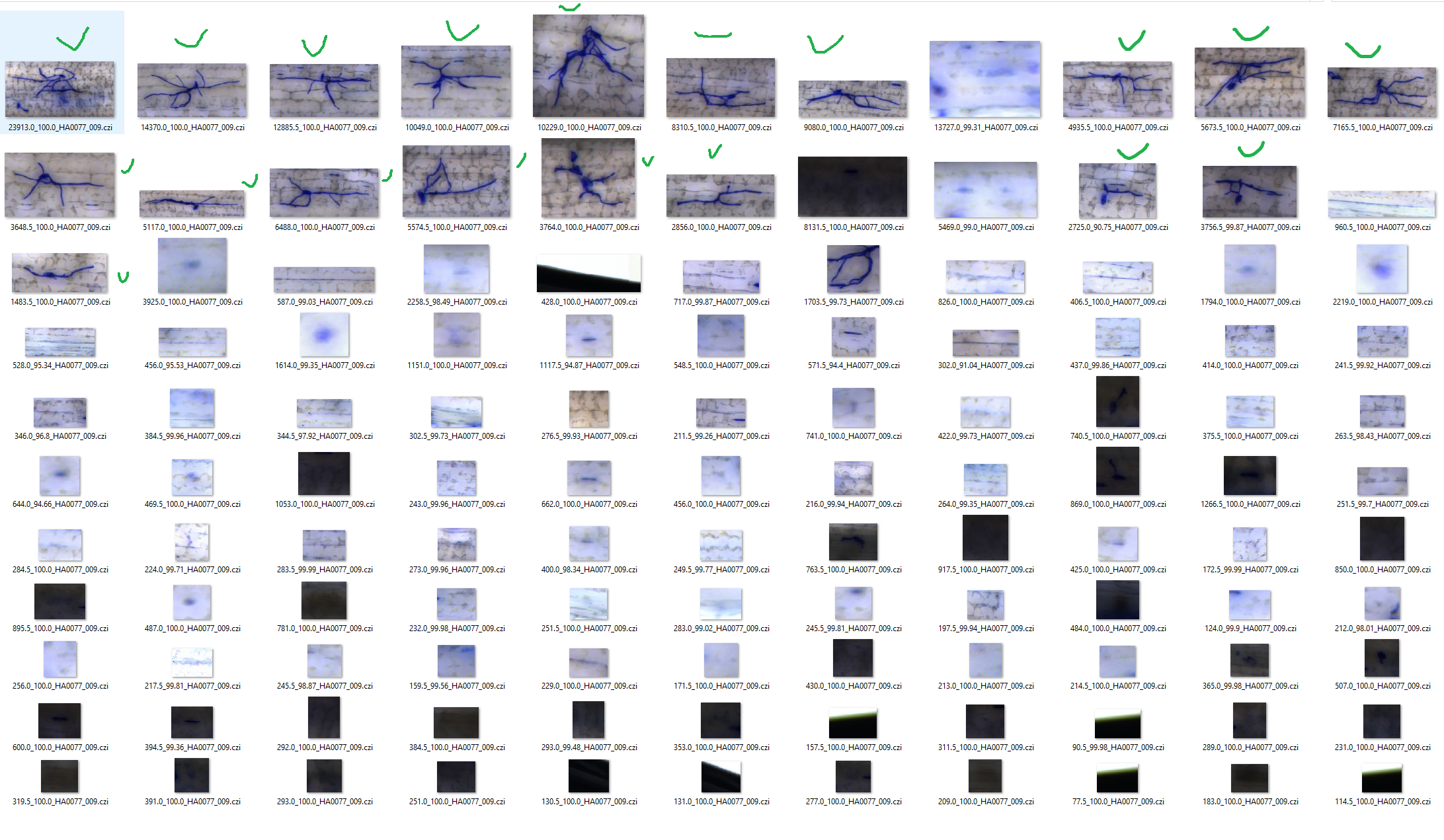
Here is a screenshot of some example images from a validation set (screenshot), green marked are correct classified, the rest are false positives. Any suggestion, how to improve my model?
Edit: I add also the code for pre-processing the images:
import matplotlib
matplotlib.use("Agg")
from smallvggnet import SmallVGGNet
from sklearn.preprocessing import LabelBinarizer
from sklearn.model_selection import train_test_split
from sklearn.metrics import classification_report
from tensorflow.keras.preprocessing.image import ImageDataGenerator
from tensorflow.keras.optimizers import SGD
from imutils import paths
import matplotlib.pyplot as plt
import numpy as np
import argparse
import random
import pickle
import cv2
import os
from keras.utils.np_utils import to_categorical

# initialize the data and labels
print("[INFO] loading images...")
data = []
labels = []
# grab the image paths and randomly shuffle them
imagePaths = sorted(list(paths.list_images("C:/06112020_hyphae/all/")))
random.seed(42)
random.shuffle(imagePaths)
# loop over the input images
for imagePath in imagePaths:

    image = cv2.imread(imagePath)
    image = cv2.resize(image, (350, 150))
    data.append(image)

    label = imagePath.split(os.path.sep)[-2].split('/')[-1]
    if label == 'pos':
        label = 1
    else:
        label = 0
    labels.append(label)

# scale the raw pixel intensities to the range [0, 1]
data = np.array(data, dtype="float") / 255.0
labels = np.array(labels)


# partition the data into training and testing splits using 75% of
# the data for training and the remaining 25% for testing
(trainX, testX, trainY, testY) = train_test_split(data, labels, test_size=0.25, random_state=42)
unique, counts = np.unique(trainY, return_counts=True)
print (dict(zip(unique, counts)))

trainY = to_categorical(trainY)
testY = to_categorical(testY)

# construct the image generator for data augmentation
#aug = ImageDataGenerator(rotation_range=30, width_shift_range=0.1, height_shift_range=0.1, zoom_range=0.2, horizontal_flip=True, fill_mode="nearest")
aug = ImageDataGenerator()

# initialize our VGG-like Convolutional Neural Network
model = SmallVGGNet.build(width=350, height=150, depth=3,
    classes=2)

# initialize our initial learning rate, # of epochs to train for,
# and batch size
INIT_LR = 0.01
EPOCHS = 20
BS = 32
# initialize the model and optimizer (you'll want to use
# binary_crossentropy for 2-class classification)
print("[INFO] training network...")
opt = SGD(lr=INIT_LR, decay=INIT_LR / EPOCHS)
model.compile(loss="binary_crossentropy", optimizer=opt,
    metrics=["accuracy"])
# train the network
H = model.fit(x=aug.flow(trainX, trainY, batch_size=BS),
    validation_data=(testX, testY), steps_per_epoch=len(trainX) // BS,
    epochs=EPOCHS)