
Warning: these are noob questions, since I'm really new to Julia.
In R, there is quite an "unified" function to export (almost) any kind of object with read.table(). It looks like things are slightly more complicated in Julia. If I understand well:
Some standard types (e.g., arrays, dictionaries and tuples) can always be exported with
writedlm, but not always withCSV.write. Conversely, DataFrames can always be exported withCSV.write, but never withwritedlm. Is this correct? Thus, there is no "universal exporter", in a similar sense of R'swrite.table()?Along with writing a CSV file,
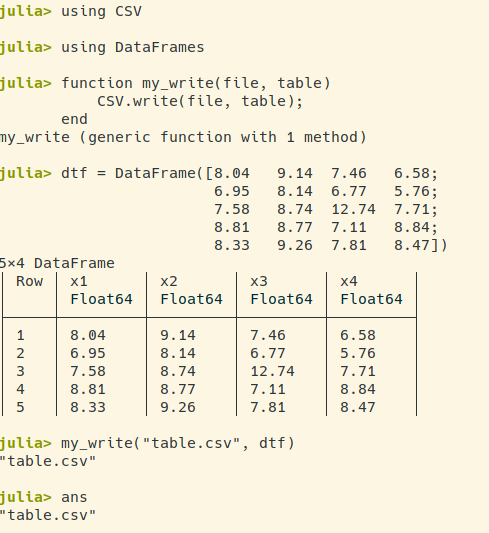
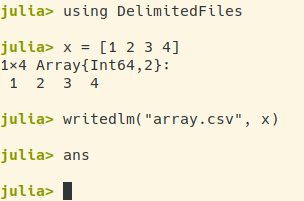
CSV.writealso seems to return the name of the exported file. Conversely,writedlmdoes not. This is a problem for me. Actually, I would need a way to export a DataFrame into a CSV file with a function which does not return a value, i.e. a function which only has side effects, likewritedlm. Is there any way to achieve this in Julia?EDIT: To go into more details, my problem is that after a
CSV.write,anspoints towards the name of the exported file; and this is not the case withwritedlm. An illustration here and here. Even with the idea given by @Przemyslaw Szufel, I can't get rid of this. (This is quite a subtle problem, but I'm actually trying to write a emacs lisp backend for Julia. This kind of inconsistencies, e.g. not knowing whetheranswill benothingor a filename after exporting an object, adds some more pain in this adventure... :-) Ideally, I just had wanted thatCSV.writecould be silent.)
Thanks!