
This question is almost a duplicate of the post from Cross Validated, but none has replied to that and I hope it is okay I ask almost the same question here.
I have been reading and looking at implementations of the SRGAN, from Photo-realistic Single Image Super Resolution with Generative Adversarial Networks. I implemented the PyTorch implementation of SRGAN for 3 channel images and it makes some decent super resolution images. However, when I try it out with 1 channel images it fails to generate plausible images.
The grayscale images I use is from the public release MSTAR of high resolution Synthetic Aparture Radar (SAR) data from sdms. The dataset contains of 2774 images and has 10 classes. Some samples are shown below:

Since SRGAN use VGG as one of the networks I had to convert my grayscale images to RGB. I copied the first channel to the other two channels and created a 3 channel image by the following approach:
    w, h = hr_image.shape
    ret = np.empty((w, h, 3), dtype=np.uint8)
    ret[:, :, :] = hr_image[:, :, np.newaxis]
    hr_image = ret
The following are the output after 34 epochs (this continues) and is low resolution, high resolution, super resolution.

What I notice is that the Discriminators loss quickly goes to 0, Generators loss to 0.08, generators score to 0 and discriminators score to 1. I assume this means that it is too easy for the discriminator to distinguish between the real and fake image. This presumable causes the generator to not learn anything new and just stops learning.
I tried to isolate one class in the MSTAR dataset, but that did not change anything. I noticed that others Super-resolution SAR Image Reconstruction via Generative Adversarial Network did use SRGAN for SAR images and it seems to work, but their paper does not explain how they implemented it.
I am wondering if I am using the wrong approach and need to change the loss functions. SRGAN is using MSE, TVLoss and perceptual loss. MSE is by itself not the best loss functions and is explained really well on here. But it is probably good to keep the images inside the MSE-hypersphere. But I ask myself whether it make sense to use a network that is trained on low frequency images and use it on high frequency images? As I understand it the loss functions are designed to work really well on low frequency images (something our eyes like to look at) and not that much on high frequency images. My questions are therefore:
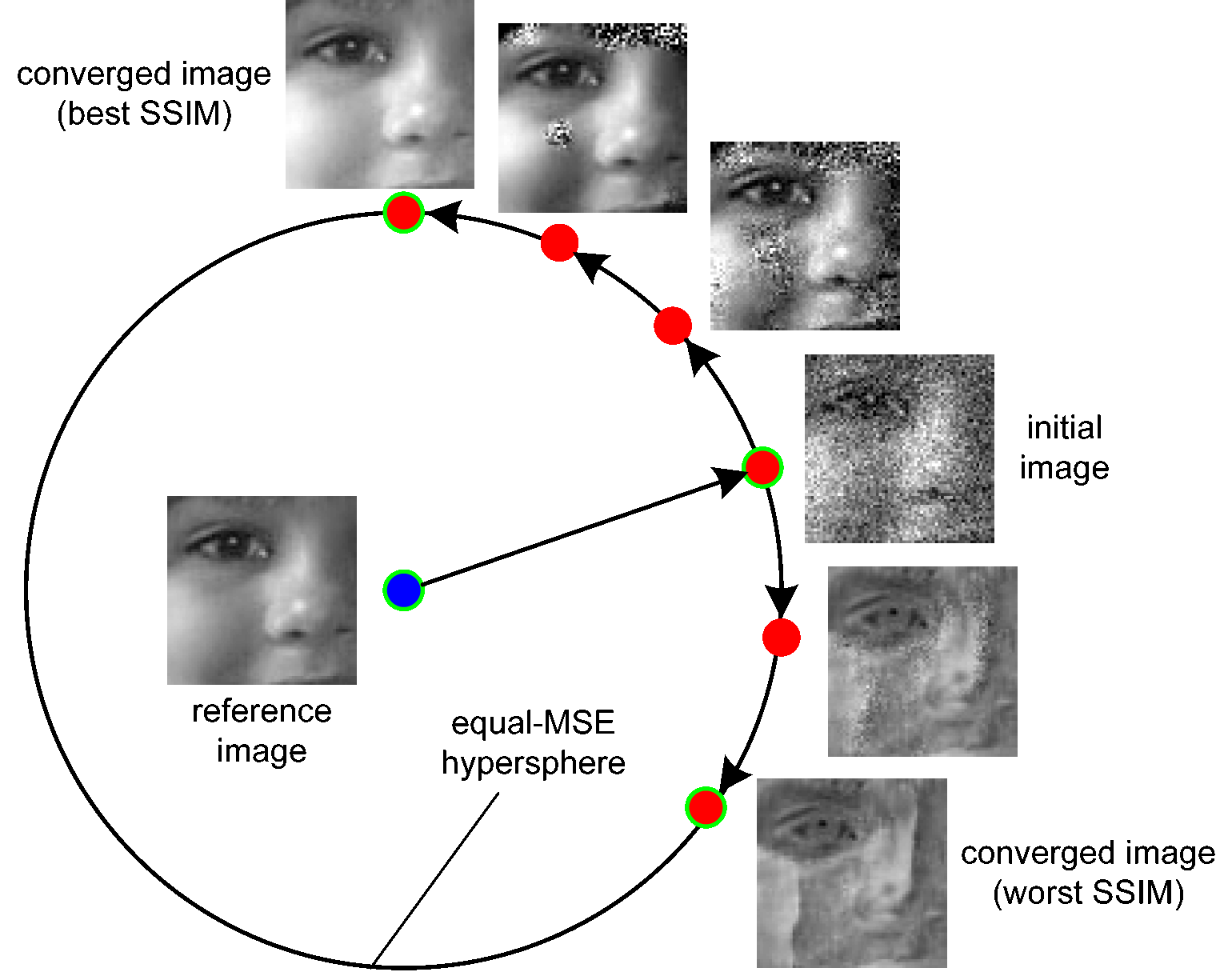
- Should I change the loss functions? Should I pre train my own network with high frequency grayscale images so the network are more suitable for these images?
- How come the generator crashing after few epochs? Why is it so hard for the generator to make plausible transformations? Are the images too "noisy"?
- Should I change something in the structure of the generator and discriminator? And should I try to use another pretrained network that is more suitable for grayscale images, and if so, which one?
- Should I use a pretrained network that is trained on high frequency images?
UPDATED TEXT 11 JUNE 2020 BECAUSE OF NEW RESULTS
Instead of converting all my images to 3 channels I only did this before the VGG network in line 22 by the following command:
    out_images = out_images.repeat(1,3, 1,1)
    target_images = target_images.repeat(1, 3, 1,1)
I also made some minor changes in my code and this changed the output of the model after 250:

However as can be seen it did not improve in making the super resolution image. The discriminators quickly learns to distinguish between real and fake images as can be seen on the loss plot below:

Does anyone has any suggestions on how I can make the generator stronger? I tried to add more layers in the generator and removed some of the discriminator but with no success.