
I am wondering how to predict and get future time series data after model training. I would like to get the values after N steps. I wonder if the time series data has been properly learned and predicted. How do I do this right to get the following(next) value? I want to get the next value using model.predict or similar.
I have x_test and x_test[-1] == t So, the meaning of the next value is t+1, t+2, .... t+n. In this example I want to get t+1, t+2 ... t+n
First
I tried using stock index data
inputs = total_data[len(total_data) - forecast - look_back:]
inputs = scaler.transform(inputs)
X_test = []
for i in range(look_back, inputs.shape[0]):
    X_test.append(inputs[i - look_back:i])
X_test = np.array(X_test)
predicted = model.predict(X_test)
but the result is like below
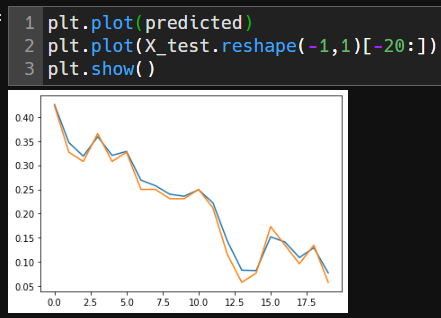
The results from X_test[-20:] and the following 20 predictions looks like same. I'm wondering if it's the correct method to train and predicted value and also if the result was correct.
The method I tried first did not work correctly.
Second
I realized something is wrong, I tried using another official data so I used the time series in the Tensorflow tutorial to practice training the model.
a = y_val[-look_back:]
for i in range(N-step prediction): #predict a new value n times.
    tmp = model.predict(a.reshape(-1, look_back, num_feature)) #predicted value
    a = a[1:] #remove first
    a = np.append(a, tmp) #insert predicted value
The results were predicted in a linear regression shape very differently from the real data.
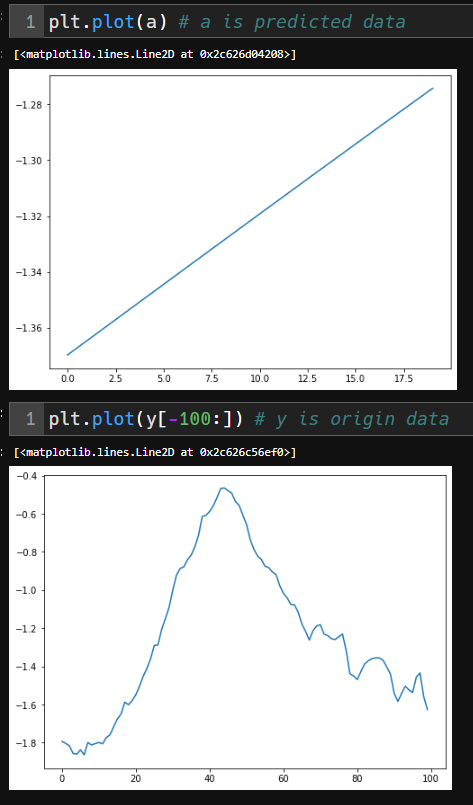
Output a linear regression abnormal that is independent of the real data:
full source (After the 25th line is my code.)
I'm really very curious that How can I predict the following value of time series using Tensorflow predict method
I'm not wondering if this works or not theoretically. I'm just wondering how to get the following n steps using the predict method.
Thank you for reading the long question. I seek advice about your priceless opinion.
