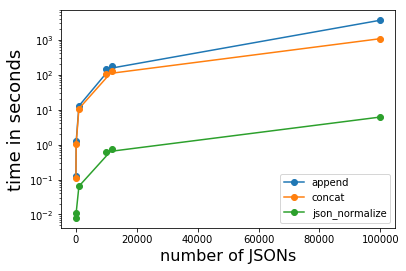
The fastest way of converting JSON strings to dataframes seems to be pd.io.json.json_normalize. Depending on the number of JSONs it is about 15 to >500 times faster than appending to an existing dataframe. It beats pd.concat by a factor of 13 to 170.
The side effect is that the nested part of the JSON (group_properties and user_properties) gets flattened as well and that the dtypes need to be set manually.
Runtime for 12,000 JSONs (not taking disk I/O into consideration)
- append: ~177 sec
- concat: ~126 sec
- json_normalize: ~0.7 sec
import pandas as pd
import json
import os

data = []
for filename in os.listdir('path'):
    with open(filename, 'r') as f:
        data.append(f)

# read one JSON and use it as a reference dataframe
df_ref = pd.read_json(data[0], lines=True)

# create a temporary dataframe, get its column 0 and flatten it via json_normalize
df_temp = pd.DataFrame(data)[0]
df = pd.io.json.json_normalize(df_temp.apply(json.loads))

# fix the column dtypes
for col, dtype in df_ref.dtypes.to_dict().items():
    if col not in df.columns:
        continue
    df[col] = df[col].astype(dtype, inplace=True)
Complete Code
import pandas as pd
import json
import time

j = {'$schema': 12,
 'amplitude_id': None,
 'app': '',
 'city': ' ',
 'device_carrier': None,
 'dma': ' ',
 'event_time': '2018-03-12 22:00:01.646000',
 'group_properties': {'[Segment] Group': {'': {}}},
 'ip_address': ' ',
 'os_version': None,
 'paying': None,
 'platform': 'analytics-ruby',
 'processed_time': '2018-03-12 22:00:06.004940',
 'server_received_time': '2018-03-12 22:00:02.993000',
 'user_creation_time': '2018-01-12 18:57:20.212000',
 'user_id': ' ',
 'user_properties': {'initial_referrer': '',
  'last_name': '',
  'organization_id': 2},
 'uuid': ' ',
 'version_name': None}

json_str = json.dumps(j)

def df_append():
    t0 = time.time()
    df = pd.DataFrame()
    for _ in range(n_lines):
        file_read1 = pd.read_json(json_str, lines=True)
        df = df.append(file_read1, ignore_index=True)
    return df, time.time() - t0

def df_concat():
    t0 = time.time()
    data = []
    for _ in range(n_lines):
        file_read1 = pd.read_json(json_str, lines=True)
        data.append(file_read1)

    df = pd.concat(data)
    df.index = list(range(len(df)))
    return df, time.time() - t0

def df_io_json():
    df_ref = pd.read_json(json_str, lines=True)
    t0 = time.time()
    data = []
    for _ in range(n_lines):
        data.append(json_str)

    df = pd.io.json.json_normalize(pd.DataFrame(data)[0].apply(json.loads))
    for col, dtype in df_ref.dtypes.to_dict().items():
        if col not in df.columns:
            continue
        df[col] = df[col].astype(dtype, inplace=True)
    return df, time.time() - t0


n_datapoints = (10, 10**2, 10**3, 12000, 10**4, 10**5)
times = {}
for n_lines in n_datapoints:
    times[n_lines] = [[], [], []]
    for _ in range(3):
        df1, t1 = df_append()
        df2, t2 = df_concat()
        df3, t3 = df_io_json()
        times[n_lines][0].append(t1)
        times[n_lines][1].append(t2)
        times[n_lines][2].append(t3)
        pd.testing.assert_frame_equal(df1, df2)
        pd.testing.assert_frame_equal(df1[df1.columns[0:7]], df3[df3.columns[0:7]])
        pd.testing.assert_frame_equal(df2[df2.columns[8:16]], df3[df3.columns[7:15]])
        pd.testing.assert_frame_equal(df2[df2.columns[17:]], df3[df3.columns[18:]])
    for i in range(3):
        times[n_lines][i] = sum(times[n_lines][i]) / 3
times

x = n_datapoints

fig = plt.figure()

plt.plot(x, [t[0] for t in times.values()], 'o-', label='append')
plt.plot(x, [t[1] for t in times.values()], 'o-', label='concat')
plt.plot(x, [t[2] for t in times.values()], 'o-', label='json_normalize')

plt.xlabel('number of JSONs', fontsize=16)
plt.ylabel('time in seconds', fontsize=18)
plt.yscale('log')

plt.legend()
plt.show()
