
In Attention Is All You Need, the authors implement a positional embedding (which adds information about where a word is in a sequence). For this, they use a sinusoidal embedding:
PE(pos,2i) = sin(pos/10000**(2*i/hidden_units))
PE(pos,2i+1) = cos(pos/10000**(2*i/hidden_units))
where pos is the position and i is the dimension. It must result in an embedding matrix of shape [max_length, embedding_size], i.e., given a position in a sequence, it returns the tensor of PE[position,:].
I found the Kyubyong's implementation, but I do not fully understand it.
I tried to implement it in numpy the following way:
hidden_units = 100 # Dimension of embedding
vocab_size = 10 # Maximum sentence length
# Matrix of [[1, ..., 99], [1, ..., 99], ...]
i = np.tile(np.expand_dims(range(hidden_units), 0), [vocab_size, 1])
# Matrix of [[1, ..., 1], [2, ..., 2], ...]
pos = np.tile(np.expand_dims(range(vocab_size), 1), [1, hidden_units])
# Apply the intermediate funcitons
pos = np.multiply(pos, 1/10000.0)
i = np.multiply(i, 2.0/hidden_units)
matrix = np.power(pos, i)
# Apply the sine function to the even colums
matrix[:, 1::2] = np.sin(matrix[:, 1::2]) # even
# Apply the cosine function to the odd columns
matrix[:, ::2] = np.cos(matrix[:, ::2]) # odd
# Plot
im = plt.imshow(matrix, cmap='hot', aspect='auto')
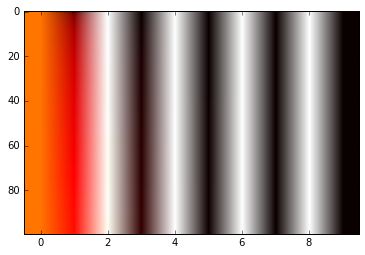
I don't understand how this matrix can give information on the position of inputs. Could someone first tell me if this is the right way to compute it and second what is the rationale behind it?
Thank you.
