
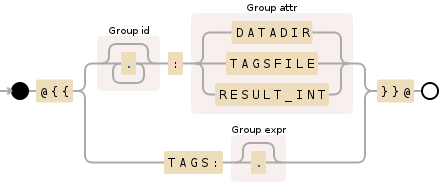
I've attempted to encode the following EBNF grammar for my system's macros into a regular expression (below), but despite my best efforts it appears to greedily match across multiple macros: it doesn't stop at the closing }}@.
    Expand ``@{{...}}@`` references which may appear in Step parameters.
    The syntax is described by the following EBNF grammar::

        depdata = "@{{", source identifier, ":", attribute, "}}@"
                | "@{{TAGS:", expression, "}}@" ;
        source identifier = ? printable 7-bit ASCII ? ;
        attribute = "DATADIR" | "TAGSFILE" | "RESULT_INT" ;
        expression = ? printable 7-bit ASCII ? ;
and the Python regular expression I've come up with
@{{(?:(?:(?P<id>.*?):(?P<attr>DATADIR|TAGSFILE|RESULT_INT))|TAGS:(?P<expr>.+?))}}@
Edit: Added missing + within expr group
When finding all the matches in the following test-case, I expect the result to be three matches, but I only get two:
@{{TAGS:sTagsJob << "job||ID||source"}}@ test @{{job:DATADIR}}@ email body @{{job:DATADIR}}@ blah
The matches I expect are:
@{{TAGS:sTagsJob << "job||ID||source"}}@with theexprgroup set@{{job:DATADIR}}@withidandattrgroups set@{{job:DATADIR}}@(again) withidandattrgroups set
But instead, the matches are:
@{{TAGS:sTagsJob << "job||ID||source"}}@ test @{{job:DATADIR}}@@{{job:DATADIR}}@
How come the non-greedy matches (.+?) seem to be acting greedy? What have I missed?
(And yes, I'm aware the EBNF grammar is silly and could be improved by always having the fixed strings appear on the right hand side. But that's not my question: I want to learn why my regex-fu has failed me)