I want to learn more about using the SSE.
What ways are there to learn, besides the obvious reading the Intel® 64 and IA-32 Architectures Software Developer's Manuals?
Mainly I'm interested to work with the GCC X86 Built-in Functions.
I want to learn more about using the SSE.
What ways are there to learn, besides the obvious reading the Intel® 64 and IA-32 Architectures Software Developer's Manuals?
Mainly I'm interested to work with the GCC X86 Built-in Functions.
Step 1: write some assembly manually
I recommend that you first try to write your own assembly manually to see and control exactly what is happening when you start learning.
Then the question becomes how to observe what is happening in the program, and the answers are:
print and assert thingsUsing the C standard library yourself requires a little bit of work, but nothing much. I have for example done this work nicely for you on Linux in the following files of my test setup:
Using those helpers, I then start playing around with the basics, such as:
addpd.S
#include <lkmc.h>

LKMC_PROLOGUE
.data
    .align 16
    addps_input0: .float 1.5, 2.5,  3.5,  4.5
    addps_input1: .float 5.5, 6.5,  7.5,  8.5
    addps_expect: .float 7.0, 9.0, 11.0, 13.0
    addpd_input0: .double 1.5, 2.5
    addpd_input1: .double 5.5, 6.5
    addpd_expect: .double 7.0, 9.0
.bss
    .align 16
    output:       .skip 16
.text
    /* 4x 32-bit */
    movaps addps_input0, %xmm0
    movaps addps_input1, %xmm1
    addps %xmm1, %xmm0
    movaps %xmm0, output
    LKMC_ASSERT_MEMCMP(output, addps_expect, $0x10)

    /* 2x 64-bit */
    movaps addpd_input0, %xmm0
    movaps addpd_input1, %xmm1
    addpd %xmm1, %xmm0
    movaps %xmm0, output
    LKMC_ASSERT_MEMCMP(output, addpd_expect, $0x10)
LKMC_EPILOGUE
paddq.S
#include <lkmc.h>

LKMC_PROLOGUE
.data
    .align 16
    input0:       .long 0xF1F1F1F1, 0xF2F2F2F2, 0xF3F3F3F3, 0xF4F4F4F4
    input1:       .long 0x12121212, 0x13131313, 0x14141414, 0x15151515
    paddb_expect: .long 0x03030303, 0x05050505, 0x07070707, 0x09090909
    paddw_expect: .long 0x04030403, 0x06050605, 0x08070807, 0x0A090A09
    paddd_expect: .long 0x04040403, 0x06060605, 0x08080807, 0x0A0A0A09
    paddq_expect: .long 0x04040403, 0x06060606, 0x08080807, 0x0A0A0A0A
.bss
    .align 16
    output:       .skip 16
.text
    movaps input1, %xmm1

    /* 16x 8bit */
    movaps input0, %xmm0
    paddb %xmm1, %xmm0
    movaps %xmm0, output
    LKMC_ASSERT_MEMCMP(output, paddb_expect, $0x10)

    /* 8x 16-bit */
    movaps input0, %xmm0
    paddw %xmm1, %xmm0
    movaps %xmm0, output
    LKMC_ASSERT_MEMCMP(output, paddw_expect, $0x10)

    /* 4x 32-bit */
    movaps input0, %xmm0
    paddd %xmm1, %xmm0
    movaps %xmm0, output
    LKMC_ASSERT_MEMCMP(output, paddd_expect, $0x10)

    /* 2x 64-bit */
    movaps input0, %xmm0
    paddq %xmm1, %xmm0
    movaps %xmm0, output
    LKMC_ASSERT_MEMCMP(output, paddq_expect, $0x10)

LKMC_EPILOGUE
Step 2: write some intrinsics
For production code however, you will likely want to use the pre-existing intrinsics instead of raw assembly as mentioned at: https://stackoverflow.com/a/1390802/895245
So now I try to convert the previous examples into more or less equivalent C code with intrinsics.
addpq.c
#include <assert.h>
#include <string.h>

#include <x86intrin.h>

float global_input0[] __attribute__((aligned(16))) = {1.5f, 2.5f, 3.5f, 4.5f};
float global_input1[] __attribute__((aligned(16))) = {5.5f, 6.5f, 7.5f, 8.5f};
float global_output[4] __attribute__((aligned(16)));
float global_expected[] __attribute__((aligned(16))) = {7.0f, 9.0f, 11.0f, 13.0f};

int main(void) {
    /* 32-bit add (addps). */
    {
        __m128 input0 = _mm_set_ps(1.5f, 2.5f, 3.5f, 4.5f);
        __m128 input1 = _mm_set_ps(5.5f, 6.5f, 7.5f, 8.5f);
        __m128 output = _mm_add_ps(input0, input1);
        /* _mm_extract_ps returns int instead of float:
        * * https://stackoverflow.com/questions/5526658/intel-sse-why-does-mm-extract-ps-return-int-instead-of-float
        * * https://stackoverflow.com/questions/3130169/how-to-convert-a-hex-float-to-a-float-in-c-c-using-mm-extract-ps-sse-gcc-inst
        * so we must use instead: _MM_EXTRACT_FLOAT
        */
        float f;
        _MM_EXTRACT_FLOAT(f, output, 3);
        assert(f == 7.0f);
        _MM_EXTRACT_FLOAT(f, output, 2);
        assert(f == 9.0f);
        _MM_EXTRACT_FLOAT(f, output, 1);
        assert(f == 11.0f);
        _MM_EXTRACT_FLOAT(f, output, 0);
        assert(f == 13.0f);

        /* And we also have _mm_cvtss_f32 + _mm_shuffle_ps, */
        assert(_mm_cvtss_f32(output) == 13.0f);
        assert(_mm_cvtss_f32(_mm_shuffle_ps(output, output, 1)) == 11.0f);
        assert(_mm_cvtss_f32(_mm_shuffle_ps(output, output, 2)) ==  9.0f);
        assert(_mm_cvtss_f32(_mm_shuffle_ps(output, output, 3)) ==  7.0f);
    }

    /* Now from memory. */
    {
        __m128 *input0 = (__m128 *)global_input0;
        __m128 *input1 = (__m128 *)global_input1;
        _mm_store_ps(global_output, _mm_add_ps(*input0, *input1));
        assert(!memcmp(global_output, global_expected, sizeof(global_output)));
    }

    /* 64-bit add (addpd). */
    {
        __m128d input0 = _mm_set_pd(1.5, 2.5);
        __m128d input1 = _mm_set_pd(5.5, 6.5);
        __m128d output = _mm_add_pd(input0, input1);
        /* OK, and this is how we get the doubles out:
        * with _mm_cvtsd_f64 + _mm_unpackhi_pd
        * https://stackoverflow.com/questions/19359372/mm-cvtsd-f64-analogon-for-higher-order-floating-point
        */
        assert(_mm_cvtsd_f64(output) == 9.0);
        assert(_mm_cvtsd_f64(_mm_unpackhi_pd(output, output)) == 7.0);
    }

    return 0;
}
paddq.c
#include <assert.h>
#include <inttypes.h>
#include <string.h>

#include <x86intrin.h>

uint32_t global_input0[] __attribute__((aligned(16))) = {1, 2, 3, 4};
uint32_t global_input1[] __attribute__((aligned(16))) = {5, 6, 7, 8};
uint32_t global_output[4] __attribute__((aligned(16)));
uint32_t global_expected[] __attribute__((aligned(16))) = {6, 8, 10, 12};

int main(void) {

    /* 32-bit add hello world. */
    {
        __m128i input0 = _mm_set_epi32(1, 2, 3, 4);
        __m128i input1 = _mm_set_epi32(5, 6, 7, 8);
        __m128i output = _mm_add_epi32(input0, input1);
        /* _mm_extract_epi32 mentioned at:
        * https://stackoverflow.com/questions/12495467/how-to-store-the-contents-of-a-m128d-simd-vector-as-doubles-without-accessing/56404421#56404421 */
        assert(_mm_extract_epi32(output, 3) == 6);
        assert(_mm_extract_epi32(output, 2) == 8);
        assert(_mm_extract_epi32(output, 1) == 10);
        assert(_mm_extract_epi32(output, 0) == 12);
    }

    /* Now from memory. */
    {
        __m128i *input0 = (__m128i *)global_input0;
        __m128i *input1 = (__m128i *)global_input1;
        _mm_store_si128((__m128i *)global_output, _mm_add_epi32(*input0, *input1));
        assert(!memcmp(global_output, global_expected, sizeof(global_output)));
    }

    /* Now a bunch of other sizes. */
    {
        __m128i input0 = _mm_set_epi32(0xF1F1F1F1, 0xF2F2F2F2, 0xF3F3F3F3, 0xF4F4F4F4);
        __m128i input1 = _mm_set_epi32(0x12121212, 0x13131313, 0x14141414, 0x15151515);
        __m128i output;

        /* 8-bit integers (paddb) */
        output = _mm_add_epi8(input0, input1);
        assert(_mm_extract_epi32(output, 3) == 0x03030303);
        assert(_mm_extract_epi32(output, 2) == 0x05050505);
        assert(_mm_extract_epi32(output, 1) == 0x07070707);
        assert(_mm_extract_epi32(output, 0) == 0x09090909);

        /* 32-bit integers (paddw) */
        output = _mm_add_epi16(input0, input1);
        assert(_mm_extract_epi32(output, 3) == 0x04030403);
        assert(_mm_extract_epi32(output, 2) == 0x06050605);
        assert(_mm_extract_epi32(output, 1) == 0x08070807);
        assert(_mm_extract_epi32(output, 0) == 0x0A090A09);

        /* 32-bit integers (paddd) */
        output = _mm_add_epi32(input0, input1);
        assert(_mm_extract_epi32(output, 3) == 0x04040403);
        assert(_mm_extract_epi32(output, 2) == 0x06060605);
        assert(_mm_extract_epi32(output, 1) == 0x08080807);
        assert(_mm_extract_epi32(output, 0) == 0x0A0A0A09);

        /* 64-bit integers (paddq) */
        output = _mm_add_epi64(input0, input1);
        assert(_mm_extract_epi32(output, 3) == 0x04040404);
        assert(_mm_extract_epi32(output, 2) == 0x06060605);
        assert(_mm_extract_epi32(output, 1) == 0x08080808);
        assert(_mm_extract_epi32(output, 0) == 0x0A0A0A09);
    }

    return 0;
Step 3: go and optimize some code and benchmark it
The final, and most important and hard step, is of course to actually use the intrinsics to make your code fast, and then to benchmark your improvement.
Doing so, will likely require you to learn a bit about the x86 microarchitecture, which I don't know myself. CPU vs IO bound will likely be one of the things that comes up: What do the terms "CPU bound" and "I/O bound" mean?
As mentioned at: https://stackoverflow.com/a/12172046/895245 this will almost inevitably involve reading Agner Fog's documentation, which appear to be better than anything Intel itself has published.
Hopefully however steps 1 and 2 will serve as a basis to at least experiment with functional non-performance aspects and quickly see what instructions are doing.
TODO: produce a minimal interesting example of such optimization here.
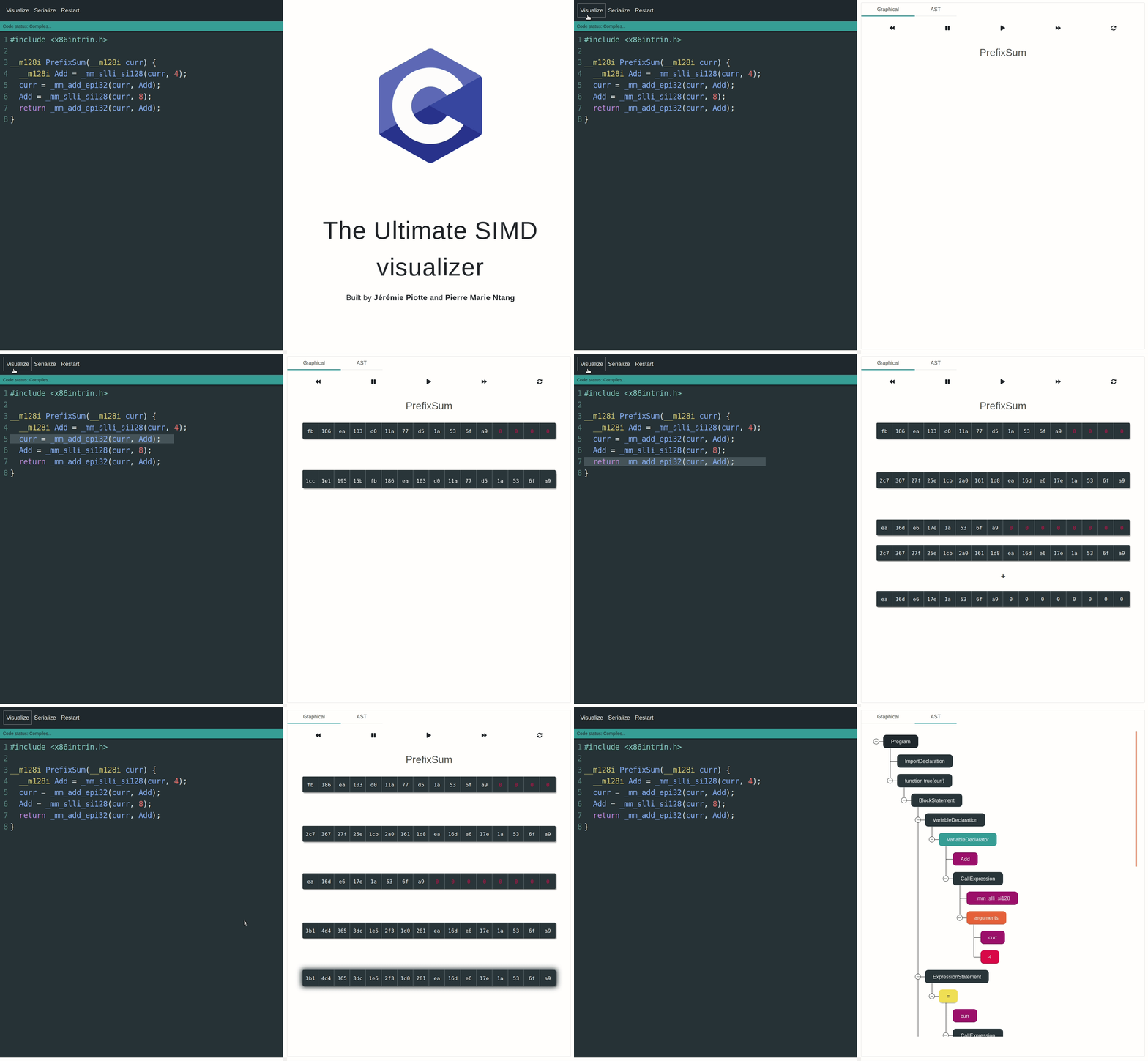
You can use the SIMD-Visualiser to graphically visualize and animate the operations. It'll greatly help understanding how the data lanes are processed