SQLite - UPSERT *not* INSERT or REPLACE

Viewed 352384

http://en.wikipedia.org/wiki/Upsert

Insert Update stored proc on SQL Server

Is there some clever way to do this in SQLite that I have not thought of?

Basically I want to update three out of four columns if the record exists, If it does not exists I want to INSERT the record with the default (NUL) value for the fourth column.

The ID is a primary key so there will only ever be one record to UPSERT.

(I am trying to avoid the overhead of SELECT in order to determine if I need to UPDATE or INSERT obviously)

Suggestions?


I cannot confirm that Syntax on the SQLite site for TABLE CREATE. I have not built a demo to test it, but it doesn't seem to be supported.

If it was, I have three columns so it would actually look like:

CREATE TABLE table1( 
    id INTEGER PRIMARY KEY ON CONFLICT REPLACE, 
    Blob1 BLOB ON CONFLICT REPLACE, 
    Blob2 BLOB ON CONFLICT REPLACE, 
    Blob3 BLOB 
);

but the first two blobs will not cause a conflict, only the ID would So I assume Blob1 and Blob2 would not be replaced (as desired)


UPDATEs in SQLite when binding data are a complete transaction, meaning Each sent row to be updated requires: Prepare/Bind/Step/Finalize statements unlike the INSERT which allows the use of the reset function

The life of a statement object goes something like this:

  1. Create the object using sqlite3_prepare_v2()
  2. Bind values to host parameters using sqlite3_bind_ interfaces.
  3. Run the SQL by calling sqlite3_step()
  4. Reset the statement using sqlite3_reset() then go back to step 2 and repeat.
  5. Destroy the statement object using sqlite3_finalize().

UPDATE I am guessing is slow compared to INSERT, but how does it compare to SELECT using the Primary key?

Perhaps I should use the select to read the 4th column (Blob3) and then use REPLACE to write a new record blending the original 4th Column with the new data for the first 3 columns?
19 Answers

If you are generally doing updates I would ..

  1. Begin a transaction
  2. Do the update
  3. Check the rowcount
  4. If it is 0 do the insert
  5. Commit

If you are generally doing inserts I would

  1. Begin a transaction
  2. Try an insert
  3. Check for primary key violation error
  4. if we got an error do the update
  5. Commit

This way you avoid the select and you are transactionally sound on Sqlite.

Beginning with version 3.24.0 UPSERT is supported by SQLite.

From the documentation:

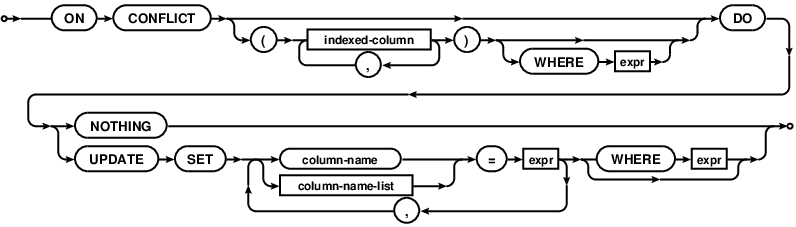
UPSERT is a special syntax addition to INSERT that causes the INSERT to behave as an UPDATE or a no-op if the INSERT would violate a uniqueness constraint. UPSERT is not standard SQL. UPSERT in SQLite follows the syntax established by PostgreSQL. UPSERT syntax was added to SQLite with version 3.24.0 (pending).

An UPSERT is an ordinary INSERT statement that is followed by the special ON CONFLICT clause

enter image description here

Image source: https://www.sqlite.org/images/syntax/upsert-clause.gif


Example:

CREATE TABLE t1(id INT PRIMARY KEY, c TEXT);
INSERT INTO t1(id, c) VALUES (1,'a'), (2, 'b');
SELECT * FROM t1;


INSERT INTO t1(id, c) VALUES (1, 'c');
-- UNIQUE constraint failed: t1.id

INSERT INTO t1(id, c) VALUES (1, 'c')
ON CONFLICT DO NOTHING;

SELECT * FROM t1;

INSERT INTO t1(id, c)
VALUES (1, 'c')
ON CONFLICT(id) DO UPDATE SET c = excluded.c;

SELECT * FROM t1;

db<>fiddle demo

Updates from Bernhardt:

You can indeed do an upsert in SQLite, it just looks a little different than you are used to. It would look something like:

INSERT INTO table_name (id, column1, column2) 
VALUES ("youruuid", "value12", "value2")
ON CONFLICT(id) DO UPDATE 
SET column1 = "value1", column2 = "value2"

The best approach I know is to do an update, followed by an insert. The "overhead of a select" is necessary, but it is not a terrible burden since you are searching on the primary key, which is fast.

You should be able to modify the below statements with your table & field names to do what you want.

--first, update any matches
UPDATE DESTINATION_TABLE DT
SET
  MY_FIELD1 = (
              SELECT MY_FIELD1
              FROM SOURCE_TABLE ST
              WHERE ST.PRIMARY_KEY = DT.PRIMARY_KEY
              )
 ,MY_FIELD2 = (
              SELECT MY_FIELD2
              FROM SOURCE_TABLE ST
              WHERE ST.PRIMARY_KEY = DT.PRIMARY_KEY
              )
WHERE EXISTS(
            SELECT ST2.PRIMARY_KEY
            FROM
              SOURCE_TABLE ST2
             ,DESTINATION_TABLE DT2
            WHERE ST2.PRIMARY_KEY = DT2.PRIMARY_KEY
            );

--second, insert any non-matches
INSERT INTO DESTINATION_TABLE(
  MY_FIELD1
 ,MY_FIELD2
)
SELECT
  ST.MY_FIELD1
 ,NULL AS MY_FIELD2  --insert NULL into this field
FROM
  SOURCE_TABLE ST
WHERE NOT EXISTS(
                SELECT DT2.PRIMARY_KEY
                FROM DESTINATION_TABLE DT2
                WHERE DT2.PRIMARY_KEY = ST.PRIMARY_KEY
                );

I think this may be what you are looking for: ON CONFLICT clause.

If you define your table like this:

CREATE TABLE table1( 
    id INTEGER PRIMARY KEY ON CONFLICT REPLACE, 
    field1 TEXT 
); 

Now, if you do an INSERT with an id that already exists, SQLite automagically does UPDATE instead of INSERT.

Hth...

If you don't mind doing this in two operations.

Steps:

1) Add new items with "INSERT OR IGNORE"

2) Update existing items with "UPDATE"

The input to both steps is the same collection of new or update-able items. Works fine with existing items that need no changes. They will be updated, but with the same data and therefore net result is no changes.

Sure, slower, etc. Inefficient. Yep.

Easy to write the sql and maintain and understand it? Definitely.

It's a trade-off to consider. Works great for small upserts. Works great for those that don't mind sacrificing efficiency for code maintainability.

Complete example of upserting using WHERE to select the newer dated record.

-- https://www.db-fiddle.com/f/7jyj4n76MZHLLk2yszB6XD/22
 
DROP TABLE IF EXISTS db;

CREATE TABLE db
(
 id PRIMARY KEY,
 updated_at,
 other
);

-- initial INSERT
INSERT INTO db (id,updated_at,other) VALUES(1,1,1);

SELECT * FROM db;

-- INSERT without WHERE
INSERT INTO db (id,updated_at,other) VALUES(1,2,2)
ON CONFLICT(id) DO UPDATE SET updated_at=excluded.updated_at;

SELECT * FROM db;

-- WHERE is FALSE
INSERT INTO db (id,updated_at,other) VALUES(1,2,3)
ON CONFLICT(id) DO UPDATE SET updated_at=excluded.updated_at, other=excluded.other
WHERE excluded.updated_at > updated_at;

SELECT * FROM db;

-- ok to SET a PRIMARY KEY. WHERE is TRUE
INSERT INTO db (id,updated_at,other) VALUES(1,3,4)
ON CONFLICT(id) DO UPDATE SET id=excluded.id, updated_at=excluded.updated_at, other=excluded.other
WHERE excluded.updated_at > updated_at;

SELECT * FROM db;
Related