
I am using the ios 11 vision framework to yield the face landmark points in real time. I am able to get the face landmark points and overlay the camera layer with the UIBezierPath of the face landmark points. However, I would like to get something like the bottom right picture. Currently I have something that looks like the left picture, and I tried looping through the points and adding midpoints, but I don't know how to generate all those triangles from the points. How would I go about generating the map on the right from the points on the left?
I'm not sure I can with all the points I have, not that it will help too much, but I also have points from the bounding box of the entire face. Lastly, is there any framework that would allow me to recognize all the points I need, such as openCV or something else, please let me know. Thanks!
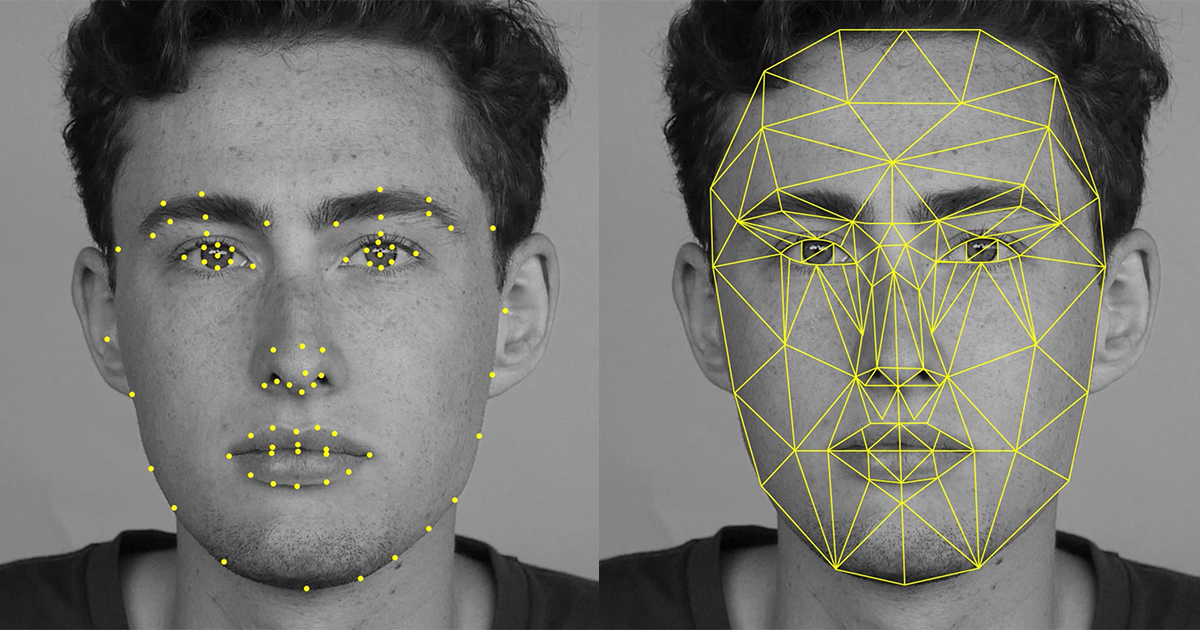
Here is the code I've been using from https://github.com/DroidsOnRoids/VisionFaceDetection:
func detectLandmarks(on image: CIImage) {
    try? faceLandmarksDetectionRequest.perform([faceLandmarks], on: image)
    if let landmarksResults = faceLandmarks.results as? [VNFaceObservation] {

        for observation in landmarksResults {

            DispatchQueue.main.async {
                if let boundingBox = self.faceLandmarks.inputFaceObservations?.first?.boundingBox {
                    let faceBoundingBox = boundingBox.scaled(to: self.view.bounds.size)
                    //different types of landmarks


                    let faceContour = observation.landmarks?.faceContour
                    self.convertPointsForFace(faceContour, faceBoundingBox)

                    let leftEye = observation.landmarks?.leftEye
                    self.convertPointsForFace(leftEye, faceBoundingBox)

                    let rightEye = observation.landmarks?.rightEye
                    self.convertPointsForFace(rightEye, faceBoundingBox)

                    let leftPupil = observation.landmarks?.leftPupil
                    self.convertPointsForFace(leftPupil, faceBoundingBox)

                    let rightPupil = observation.landmarks?.rightPupil
                    self.convertPointsForFace(rightPupil, faceBoundingBox)

                    let nose = observation.landmarks?.nose
                    self.convertPointsForFace(nose, faceBoundingBox)

                    let lips = observation.landmarks?.innerLips
                    self.convertPointsForFace(lips, faceBoundingBox)

                    let leftEyebrow = observation.landmarks?.leftEyebrow
                    self.convertPointsForFace(leftEyebrow, faceBoundingBox)

                    let rightEyebrow = observation.landmarks?.rightEyebrow
                    self.convertPointsForFace(rightEyebrow, faceBoundingBox)

                    let noseCrest = observation.landmarks?.noseCrest
                    self.convertPointsForFace(noseCrest, faceBoundingBox)

                    let outerLips = observation.landmarks?.outerLips
                    self.convertPointsForFace(outerLips, faceBoundingBox)
                }
            }
        }
    }

}

func convertPointsForFace(_ landmark: VNFaceLandmarkRegion2D?, _ boundingBox: CGRect) {
    if let points = landmark?.points, let count = landmark?.pointCount {
        let convertedPoints = convert(points, with: count)


        let faceLandmarkPoints = convertedPoints.map { (point: (x: CGFloat, y: CGFloat)) -> (x: CGFloat, y: CGFloat) in
            let pointX = point.x * boundingBox.width + boundingBox.origin.x
            let pointY = point.y * boundingBox.height + boundingBox.origin.y

            return (x: pointX, y: pointY)
        }

        DispatchQueue.main.async {
            self.draw(points: faceLandmarkPoints)
        }
    }
}


func draw(points: [(x: CGFloat, y: CGFloat)]) {
    let newLayer = CAShapeLayer()
    newLayer.strokeColor = UIColor.blue.cgColor
    newLayer.lineWidth = 4.0

    let path = UIBezierPath()
    path.move(to: CGPoint(x: points[0].x, y: points[0].y))
    for i in 0..<points.count - 1 {
        let point = CGPoint(x: points[i].x, y: points[i].y)
        path.addLine(to: point)
        path.move(to: point)
    }
    path.addLine(to: CGPoint(x: points[0].x, y: points[0].y))
    newLayer.path = path.cgPath

    shapeLayer.addSublayer(newLayer)
}