What is the difference between
- a parameter passed by reference
- a parameter passed by value?
Could you give me some examples, please?
 Admin
1
Admin
1
What is the difference between
Could you give me some examples, please?
First and foremost, the "pass by value vs. pass by reference" distinction as defined in the CS theory is now obsolete because the technique originally defined as "pass by reference" has since fallen out of favor and is seldom used now.1
Newer languages2 tend to use a different (but similar) pair of techniques to achieve the same effects (see below) which is the primary source of confusion.
A secondary source of confusion is the fact that in "pass by reference", "reference" has a narrower meaning than the general term "reference" (because the phrase predates it).
Now, the authentic definition is:
When a parameter is passed by reference, the caller and the callee use the same variable for the parameter. If the callee modifies the parameter variable, the effect is visible to the caller's variable.
When a parameter is passed by value, the caller and callee have two independent variables with the same value. If the callee modifies the parameter variable, the effect is not visible to the caller.
Things to note in this definition are:
"Variable" here means the caller's (local or global) variable itself -- i.e. if I pass a local variable by reference and assign to it, I'll change the caller's variable itself, not e.g. whatever it is pointing to if it's a pointer.
The meaning of "reference" in "pass by reference". The difference with the general "reference" term is that this "reference" is temporary and implicit. What the callee basically gets is a "variable" that is somehow "the same" as the original one. How specifically this effect is achieved is irrelevant (e.g. the language may also expose some implementation details -- addresses, pointers, dereferencing -- this is all irrelevant; if the net effect is this, it's pass-by-reference).
Now, in modern languages, variables tend to be of "reference types" (another concept invented later than "pass by reference" and inspired by it), i.e. the actual object data is stored separately somewhere (usually, on the heap), and only "references" to it are ever held in variables and passed as parameters.3
Passing such a reference falls under pass-by-value because a variable's value is technically the reference itself, not the referred object. However, the net effect on the program can be the same as either pass-by-value or pass-by-reference:
As you may see, this pair of techniques is almost the same as those in the definition, only with a level of indirection: just replace "variable" with "referenced object".
There's no agreed-upon name for them, which leads to contorted explanations like "call by value where the value is a reference". In 1975, Barbara Liskov suggested the term "call-by-object-sharing" (or sometimes just "call-by-sharing") though it never quite caught on. Moreover, neither of these phrases draws a parallel with the original pair. No wonder the old terms ended up being reused in the absence of anything better, leading to confusion.4
(I would use the terms "new" or "indirect" pass-by-value/pass-by-reference for the new techniques.)
NOTE: For a long time, this answer used to say:
Say I want to share a web page with you. If I tell you the URL, I'm passing by reference. You can use that URL to see the same web page I can see. If that page is changed, we both see the changes. If you delete the URL, all you're doing is destroying your reference to that page - you're not deleting the actual page itself.
If I print out the page and give you the printout, I'm passing by value. Your page is a disconnected copy of the original. You won't see any subsequent changes, and any changes that you make (e.g. scribbling on your printout) will not show up on the original page. If you destroy the printout, you have actually destroyed your copy of the object - but the original web page remains intact.
This is mostly correct except the narrower meaning of "reference" -- it being both temporary and implicit (it doesn't have to, but being explicit and/or persistent are additional features, not a part of the pass-by-reference semantic, as explained above). A closer analogy would be giving you a copy of a document vs inviting you to work on the original.
1Unless you are programming in Fortran or Visual Basic, it's not the default behavior, and in most languages in modern use, true call-by-reference is not even possible.
2A fair amount of older ones support it, too
3In several modern languages, all types are reference types. This approach was pioneered by the language CLU in 1975 and has since been adopted by many other languages, including Python and Ruby. And many more languages use a hybrid approach, where some types are "value types" and others are "reference types" -- among them are C#, Java, and JavaScript.
4There's nothing bad with recycling a fitting old term per se, but one has to somehow make it clear which meaning is used each time. Not doing that is exactly what keeps causing confusion.
It's a way how to pass arguments to functions. Passing by reference means the called functions' parameter will be the same as the callers' passed argument (not the value, but the identity - the variable itself). Pass by value means the called functions' parameter will be a copy of the callers' passed argument. The value will be the same, but the identity - the variable - is different. Thus changes to a parameter done by the called function in one case changes the argument passed and in the other case just changes the value of the parameter in the called function (which is only a copy). In a quick hurry:
ref used at caller and called function). Jon Skeet also has a nice explanation of this here.Codes
Since my language is C++, i will use that here
// passes a pointer (called reference in java) to an integer
void call_by_value(int *p) { // :1
    p = NULL;
}

// passes an integer
void call_by_value(int p) { // :2
    p = 42;
}

// passes an integer by reference
void call_by_reference(int & p) { // :3
    p = 42;
}

// this is the java style of passing references. NULL is called "null" there.
void call_by_value_special(int *p) { // :4
    *p = 10; // changes what p points to ("what p references" in java)
    // only changes the value of the parameter, but *not* of
    // the argument passed by the caller. thus it's pass-by-value:
    p = NULL;
}

int main() {
    int value = 10;
    int * pointer = &value;

    call_by_value(pointer); // :1
    assert(pointer == &value); // pointer was copied

    call_by_value(value); // :2
    assert(value == 10); // value was copied

    call_by_reference(value); // :3
    assert(value == 42); // value was passed by reference

    call_by_value_special(pointer); // :4
    // pointer was copied but what pointer references was changed.
    assert(value == 10 && pointer == &value);
}
And an example in Java won't hurt:
class Example {
    int value = 0;

    // similar to :4 case in the c++ example
    static void accept_reference(Example e) { // :1
        e.value++; // will change the referenced object
        e = null; // will only change the parameter
    }

    // similar to the :2 case in the c++ example
    static void accept_primitive(int v) { // :2
        v++; // will only change the parameter
    }

    public static void main(String... args) {
        int value = 0;
        Example ref = new Example(); // reference

        // note what we pass is the reference, not the object. we can't
        // pass objects. The reference is copied (pass-by-value).
        accept_reference(ref); // :1
        assert ref != null && ref.value == 1;

        // the primitive int variable is copied
        accept_primitive(value); // :2
        assert value == 0;
    }
}
Wikipedia
http://en.wikipedia.org/wiki/Pass_by_reference#Call_by_value
http://en.wikipedia.org/wiki/Pass_by_reference#Call_by_reference
This guy pretty much nails it:
Here is an example:
#include <iostream>

void by_val(int arg) { arg += 2; }
void by_ref(int&arg) { arg += 2; }

int main()
{
    int x = 0;
    by_val(x); std::cout << x << std::endl;  // prints 0
    by_ref(x); std::cout << x << std::endl;  // prints 2

    int y = 0;
    by_ref(y); std::cout << y << std::endl;  // prints 2
    by_val(y); std::cout << y << std::endl;  // prints 2
}
When passing by reference you are basically passing a pointer to the variable. Pass by value you are passing a copy of the variable.
In basic usage this normally means pass by reference, changes to the variable will seen be in the calling method and in pass by value they won’t.
Pass by value sends a copy of the data stored in the variable you specify, and pass by reference sends a direct link to the variable itself.
So if you pass a variable by reference and then change the variable inside the block you passed it into, the original variable will be changed. If you simply pass by value, the original variable will not be able to be changed by the block you passed it into, but you will get a copy of whatever it contained at the time of the call.
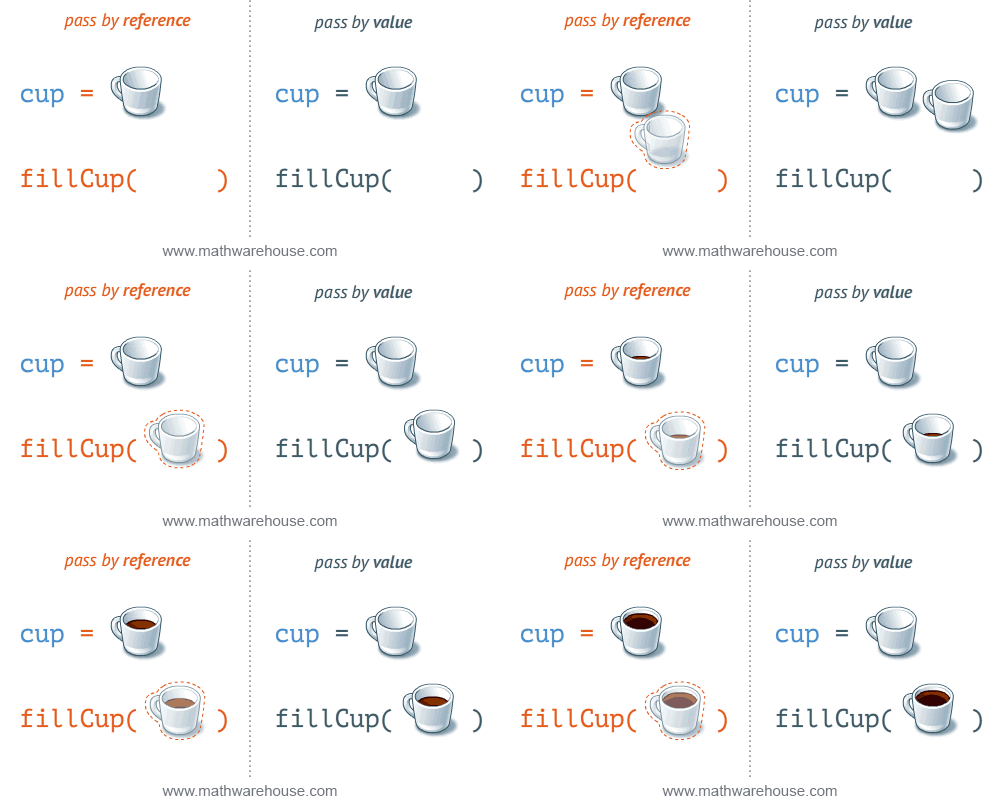
Take a look at this photo:
In the first case (pass by reference), when the variable is set or changed inside the function, the external variable also changes.
But in the second case (pass by value), changing the variable inside the function doesn't have any effect on the external variable.
For reading the article, see this link.
A major difference between them is that value-type variables store values, so specifying a value-type variable in a method call passes a copy of that variable's value to the method. Reference-type variables store references to objects, so specifying a reference-type variable as an argument passes the method a copy of the actual reference that refers to the object. Even though the reference itself is passed by value, the method can still use the reference it receives to interact with—and possibly modify—the original object. Similarly, when returning information from a method via a return statement, the method returns a copy of the value stored in a value-type variable or a copy of the reference stored in a reference-type variable. When a reference is returned, the calling method can use that reference to interact with the referenced object. So, in effect, objects are always passed by reference.
In c#, to pass a variable by reference so the called method can modify the variable's, C# provides keywords ref and out. Applying the ref keyword to a parameter declaration allows you to pass a variable to a method by reference—the called method will be able to modify the original variable in the caller. The ref keyword is used for variables that already have been initialized in the calling method. Normally, when a method call contains an uninitialized variable as an argument, the compiler generates an error. Preceding a parameter with keyword out creates an output parameter. This indicates to the compiler that the argument will be passed into the called method by reference and that the called method will assign a value to the original variable in the caller. If the method does not assign a value to the output parameter in every possible path of execution, the compiler generates an error. This also prevents the compiler from generating an error message for an uninitialized variable that is passed as an argument to a method. A method can return only one value to its caller via a return statement, but can return many values by specifying multiple output (ref and/or out) parameters.
see c# discussion and examples here link text
Examples:
class Dog
{
public:
    barkAt( const std::string& pOtherDog ); // const reference
    barkAt( std::string pOtherDog ); // value
};
const & is generally best. You don't incur the construction and destruction penalty. If the reference isn't const your interface is suggesting that it will change the passed in data.
If you don't want to change the value of the original variable after passing it into a function, the function should be constructed with a "pass by value" parameter.
Then the function will have only the value, but not the address of the passed in variable. Without the variable's address, the code inside the function cannot change the variable value as seen from the outside of the function.
But if you want to give the function the ability to change the value of the variable as seen from the outside, you need to use pass by reference. As both the value and the address (reference) are passed in and are available inside the function.
1. Pass By Value / Call By Value
   void printvalue(int x)
   {
       x = x + 1 ;
       cout << x ;  // 6
   }

   int x = 5;
   printvalue(x);
   cout << x;    // 5
In call by value, when you pass a value to printvalue(x) i.e. the argument which is 5, it is copied to void printvalue(int x). Now, we have two different values 5 and the copied value 5 and these two values are stored in different memory locations. So if you make any change inside void printvalue(int x) it won't reflect back to the argument.
2. Pass By Reference/ Call By Reference
   void printvalue(int &x)
   {
      x = x + 1 ;
      cout << x ; // 6
   }

   int x = 5;
   printvalue(x);
   cout << x;   // 6
In call by reference, there's only one difference. We use & i.e. the address operator. By doing
void printvalue(int &x) we are referring to the address of x which tells us that it both refers to the same location. Hence, any changes made inside the function will reflect outside.
Now that you're here, you should also know about ...
3. Pass By Pointer/ Call By Address
   void printvalue(int* x)
   {
      *x = *x + 1 ;
      cout << *x ; // 6
   }

   int x = 5;
   printvalue(&x);
   cout << x;   // 6
In pass by address, the pointer int* x holds the address passed to it printvalue(&x). Hence, any changes done inside the function will reflect outside.
The question is "vs".
And nobody has pointed to an important point. In passing with values, additional memory is occupied to store the passed variable values.
While in passing with a reference, no additional memory is occupied for the values (memory efficient in circumstances).
