There should be something akin to \w that can match any code-point in Letters or Marks category (not just the ASCII ones), and hopefully have filters like [[P*]] for punctuation, etc.
How can I use Unicode-aware regular expressions in JavaScript?
 Admin
1
Admin
1
Viewed 167069
11 Answers
Situation for ES 6
The ECMAScript language specification, edition 6 (also commonly known as ES2015), includes Unicode-aware regular expressions. Support must be enabled with the u modifier on the regex. See Unicode-aware regular expressions in ES6 for a break-down of the feature and some caveats.
ES6 is widely adopted in both browsers and stand-alone Javascript runtimes such as Node.js, so using this feature won't require extra effort in most cases. Full compatibility list: https://kangax.github.io/compat-table/es6/
Situation for ES 5 and below (legacy browsers)
There is a transpiler named regexpu that translates ES6 Unicode regular expressions into equivalent ES5. It can be used as part of your build process. Try it out online..
Even though JavaScript operates on Unicode strings, it does not implement Unicode-aware character classes and has no concept of POSIX character classes or Unicode blocks/sub-ranges.
Check your expectations here: Javascript RegExp Unicode Character Class tester (Edit: the original page is down, the Internet Archive still has a copy.)
Flagrant Badassery has an article on JavaScript, Regex, and Unicode that sheds some light on the matter.
Also read Regex and Unicode here on SO. Probably you have to build your own "punctuation character class".
Check out the Regular Expression: Match Unicode Block Range builder (archived copy), which lets you build a JavaScript regular expression that matches characters that fall in any number of specified Unicode blocks.
I just did it for the "General Punctuation" and "Supplemental Punctuation" sub-ranges, and the result is as simple and straight-forward as I would have expected it:
[\u2000-\u206F\u2E00-\u2E7F]There also is XRegExp, a project that brings Unicode support to JavaScript by offering an alternative regex engine with extended capabilities.
And of course, required reading: mathiasbynens.be - JavaScript has a Unicode problem:

September 2018 (updated February 2019)
It seems that regexp /\p{L}/u for match letters (as unicode categories)
- works on Chrome 68.0.3440.106 and Safari 11.1.2 (13605.3.8)
- NOT working on Firefox 65.0 :(
Here is a working example
In below field you should be able to to type letters but not numbers<br>
<input type="text" name="field" onkeydown="return /\p{L}/u.test(event.key)" >
I report this bug here.
Update
After over 2 years according to: 1500035 > 1361876 > 1634135 finally this bug is fixed and will be available in Firefox v.78+
[^\u0000-\u007F]+ for any characters which is not included ASCII characters.
For example:
function isNonLatinCharacters(s) {
    return /[^\u0000-\u007F]/.test(s);
}

console.log(isNonLatinCharacters("身分"));// Japanese
console.log(isNonLatinCharacters("测试"));// Chinese
console.log(isNonLatinCharacters("حمید"));// Persian
console.log(isNonLatinCharacters("테스트"));// Korean
console.log(isNonLatinCharacters("परीक्षण"));// Hindi
console.log(isNonLatinCharacters("מִבְחָן"));// Hebrew
Here are some perfect references:
Unicode range RegExp generator
As mentioned in other answers, JavaScript regexes have no support for Unicode character classes. However, there is a library that does provide this: Steven Levithan's excellent XRegExp and its Unicode plug-in.
In JavaScript, \w and \d are ASCII, while \s is Unicode. Don't ask me why. JavaScript does support \p with Unicode categories, which you can use to emulate a Unicode-aware \w and \d.
For \d use \p{N} (numbers)
For \w use [\p{L}\p{N}\p{Pc}\p{M}] (letters, numbers, underscores, marks)
Update: Unfortunately, I was wrong about this. JavaScript does does not officially support \p either, though some implementations may still support this. The only Unicode support in JavaScript regexes is matching specific code points with \uFFFF. You can use those in ranges in character classes.
I'm answering this question
What would be the equivalent for \p{Lu} or \p{Ll} in regExp for js?
since it was marked as an exact duplicate of the current old question.
Querying the UCD Database of Unicode 12, \p{Lu} generates 1,788 code points.
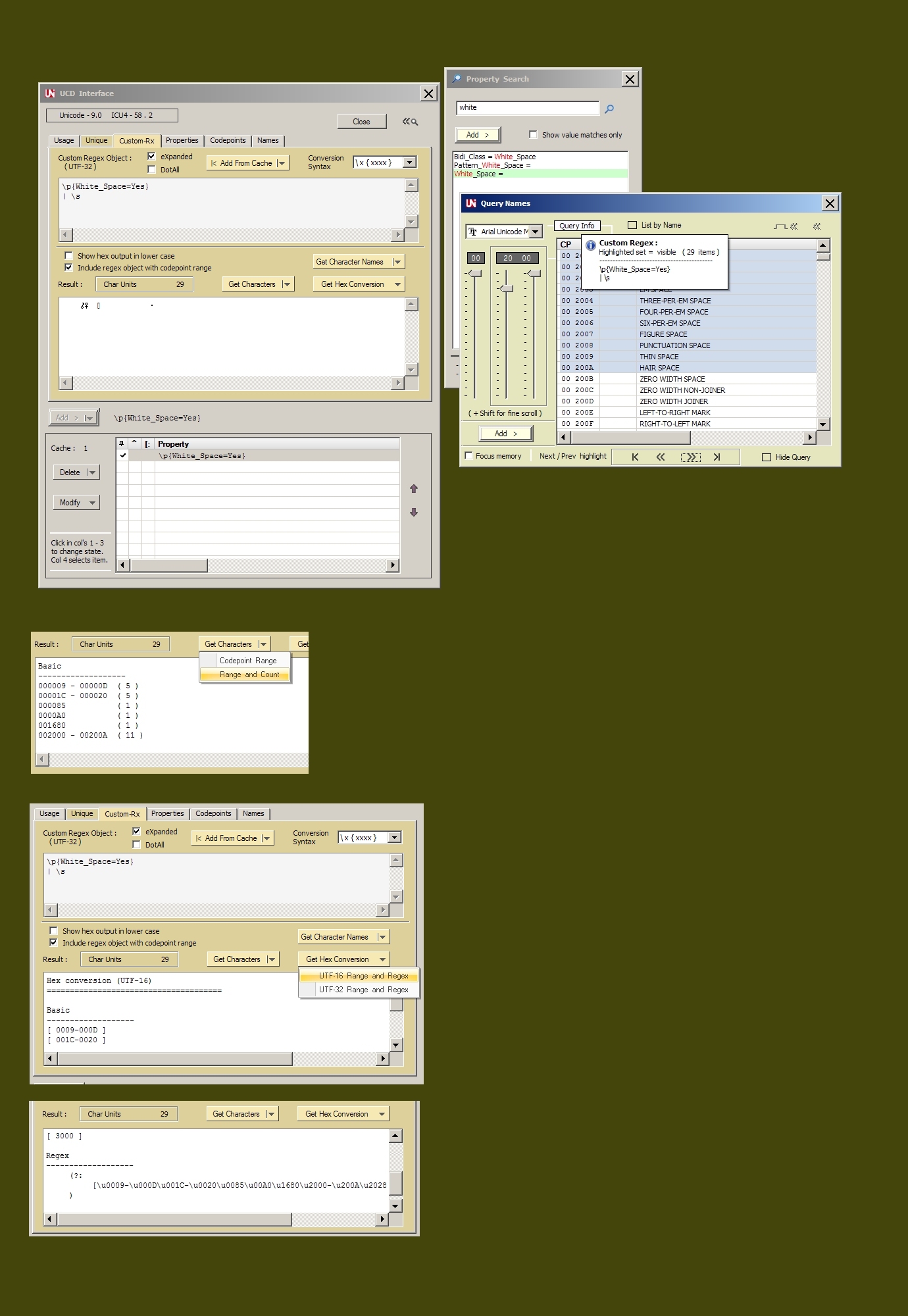
Converting to UTF-16 yields the class construct equivalency.
It's only a 4k character string and is easily doable in any regex engines.
(?:[\u0041-\u005A\u00C0-\u00D6\u00D8-\u00DE\u0100\u0102\u0104\u0106\u0108\u010A\u010C\u010E\u0110\u0112\u0114\u0116\u0118\u011A\u011C\u011E\u0120\u0122\u0124\u0126\u0128\u012A\u012C\u012E\u0130\u0132\u0134\u0136\u0139\u013B\u013D\u013F\u0141\u0143\u0145\u0147\u014A\u014C\u014E\u0150\u0152\u0154\u0156\u0158\u015A\u015C\u015E\u0160\u0162\u0164\u0166\u0168\u016A\u016C\u016E\u0170\u0172\u0174\u0176\u0178-\u0179\u017B\u017D\u0181-\u0182\u0184\u0186-\u0187\u0189-\u018B\u018E-\u0191\u0193-\u0194\u0196-\u0198\u019C-\u019D\u019F-\u01A0\u01A2\u01A4\u01A6-\u01A7\u01A9\u01AC\u01AE-\u01AF\u01B1-\u01B3\u01B5\u01B7-\u01B8\u01BC\u01C4\u01C7\u01CA\u01CD\u01CF\u01D1\u01D3\u01D5\u01D7\u01D9\u01DB\u01DE\u01E0\u01E2\u01E4\u01E6\u01E8\u01EA\u01EC\u01EE\u01F1\u01F4\u01F6-\u01F8\u01FA\u01FC\u01FE\u0200\u0202\u0204\u0206\u0208\u020A\u020C\u020E\u0210\u0212\u0214\u0216\u0218\u021A\u021C\u021E\u0220\u0222\u0224\u0226\u0228\u022A\u022C\u022E\u0230\u0232\u023A-\u023B\u023D-\u023E\u0241\u0243-\u0246\u0248\u024A\u024C\u024E\u0370\u0372\u0376\u037F\u0386\u0388-\u038A\u038C\u038E-\u038F\u0391-\u03A1\u03A3-\u03AB\u03CF\u03D2-\u03D4\u03D8\u03DA\u03DC\u03DE\u03E0\u03E2\u03E4\u03E6\u03E8\u03EA\u03EC\u03EE\u03F4\u03F7\u03F9-\u03FA\u03FD-\u042F\u0460\u0462\u0464\u0466\u0468\u046A\u046C\u046E\u0470\u0472\u0474\u0476\u0478\u047A\u047C\u047E\u0480\u048A\u048C\u048E\u0490\u0492\u0494\u0496\u0498\u049A\u049C\u049E\u04A0\u04A2\u04A4\u04A6\u04A8\u04AA\u04AC\u04AE\u04B0\u04B2\u04B4\u04B6\u04B8\u04BA\u04BC\u04BE\u04C0-\u04C1\u04C3\u04C5\u04C7\u04C9\u04CB\u04CD\u04D0\u04D2\u04D4\u04D6\u04D8\u04DA\u04DC\u04DE\u04E0\u04E2\u04E4\u04E6\u04E8\u04EA\u04EC\u04EE\u04F0\u04F2\u04F4\u04F6\u04F8\u04FA\u04FC\u04FE\u0500\u0502\u0504\u0506\u0508\u050A\u050C\u050E\u0510\u0512\u0514\u0516\u0518\u051A\u051C\u051E\u0520\u0522\u0524\u0526\u0528\u052A\u052C\u052E\u0531-\u0556\u10A0-\u10C5\u10C7\u10CD\u13A0-\u13F5\u1C90-\u1CBA\u1CBD-\u1CBF\u1E00\u1E02\u1E04\u1E06\u1E08\u1E0A\u1E0C\u1E0E\u1E10\u1E12\u1E14\u1E16\u1E18\u1E1A\u1E1C\u1E1E\u1E20\u1E22\u1E24\u1E26\u1E28\u1E2A\u1E2C\u1E2E\u1E30\u1E32\u1E34\u1E36\u1E38\u1E3A\u1E3C\u1E3E\u1E40\u1E42\u1E44\u1E46\u1E48\u1E4A\u1E4C\u1E4E\u1E50\u1E52\u1E54\u1E56\u1E58\u1E5A\u1E5C\u1E5E\u1E60\u1E62\u1E64\u1E66\u1E68\u1E6A\u1E6C\u1E6E\u1E70\u1E72\u1E74\u1E76\u1E78\u1E7A\u1E7C\u1E7E\u1E80\u1E82\u1E84\u1E86\u1E88\u1E8A\u1E8C\u1E8E\u1E90\u1E92\u1E94\u1E9E\u1EA0\u1EA2\u1EA4\u1EA6\u1EA8\u1EAA\u1EAC\u1EAE\u1EB0\u1EB2\u1EB4\u1EB6\u1EB8\u1EBA\u1EBC\u1EBE\u1EC0\u1EC2\u1EC4\u1EC6\u1EC8\u1ECA\u1ECC\u1ECE\u1ED0\u1ED2\u1ED4\u1ED6\u1ED8\u1EDA\u1EDC\u1EDE\u1EE0\u1EE2\u1EE4\u1EE6\u1EE8\u1EEA\u1EEC\u1EEE\u1EF0\u1EF2\u1EF4\u1EF6\u1EF8\u1EFA\u1EFC\u1EFE\u1F08-\u1F0F\u1F18-\u1F1D\u1F28-\u1F2F\u1F38-\u1F3F\u1F48-\u1F4D\u1F59\u1F5B\u1F5D\u1F5F\u1F68-\u1F6F\u1FB8-\u1FBB\u1FC8-\u1FCB\u1FD8-\u1FDB\u1FE8-\u1FEC\u1FF8-\u1FFB\u2102\u2107\u210B-\u210D\u2110-\u2112\u2115\u2119-\u211D\u2124\u2126\u2128\u212A-\u212D\u2130-\u2133\u213E-\u213F\u2145\u2183\u2C00-\u2C2E\u2C60\u2C62-\u2C64\u2C67\u2C69\u2C6B\u2C6D-\u2C70\u2C72\u2C75\u2C7E-\u2C80\u2C82\u2C84\u2C86\u2C88\u2C8A\u2C8C\u2C8E\u2C90\u2C92\u2C94\u2C96\u2C98\u2C9A\u2C9C\u2C9E\u2CA0\u2CA2\u2CA4\u2CA6\u2CA8\u2CAA\u2CAC\u2CAE\u2CB0\u2CB2\u2CB4\u2CB6\u2CB8\u2CBA\u2CBC\u2CBE\u2CC0\u2CC2\u2CC4\u2CC6\u2CC8\u2CCA\u2CCC\u2CCE\u2CD0\u2CD2\u2CD4\u2CD6\u2CD8\u2CDA\u2CDC\u2CDE\u2CE0\u2CE2\u2CEB\u2CED\u2CF2\uA640\uA642\uA644\uA646\uA648\uA64A\uA64C\uA64E\uA650\uA652\uA654\uA656\uA658\uA65A\uA65C\uA65E\uA660\uA662\uA664\uA666\uA668\uA66A\uA66C\uA680\uA682\uA684\uA686\uA688\uA68A\uA68C\uA68E\uA690\uA692\uA694\uA696\uA698\uA69A\uA722\uA724\uA726\uA728\uA72A\uA72C\uA72E\uA732\uA734\uA736\uA738\uA73A\uA73C\uA73E\uA740\uA742\uA744\uA746\uA748\uA74A\uA74C\uA74E\uA750\uA752\uA754\uA756\uA758\uA75A\uA75C\uA75E\uA760\uA762\uA764\uA766\uA768\uA76A\uA76C\uA76E\uA779\uA77B\uA77D-\uA77E\uA780\uA782\uA784\uA786\uA78B\uA78D\uA790\uA792\uA796\uA798\uA79A\uA79C\uA79E\uA7A0\uA7A2\uA7A4\uA7A6\uA7A8\uA7AA-\uA7AE\uA7B0-\uA7B4\uA7B6\uA7B8\uA7BA\uA7BC\uA7BE\uA7C2\uA7C4-\uA7C6\uFF21-\uFF3A]|(?:\uD801[\uDC00-\uDC27\uDCB0-\uDCD3]|\uD803[\uDC80-\uDCB2]|\uD806[\uDCA0-\uDCBF]|\uD81B[\uDE40-\uDE5F]|\uD835[\uDC00-\uDC19\uDC34-\uDC4D\uDC68-\uDC81\uDC9C\uDC9E-\uDC9F\uDCA2\uDCA5-\uDCA6\uDCA9-\uDCAC\uDCAE-\uDCB5\uDCD0-\uDCE9\uDD04-\uDD05\uDD07-\uDD0A\uDD0D-\uDD14\uDD16-\uDD1C\uDD38-\uDD39\uDD3B-\uDD3E\uDD40-\uDD44\uDD46\uDD4A-\uDD50\uDD6C-\uDD85\uDDA0-\uDDB9\uDDD4-\uDDED\uDE08-\uDE21\uDE3C-\uDE55\uDE70-\uDE89\uDEA8-\uDEC0\uDEE2-\uDEFA\uDF1C-\uDF34\uDF56-\uDF6E\uDF90-\uDFA8\uDFCA]|\uD83A[\uDD00-\uDD21]))
Querying the UCD database of Unicode 12, \p{Ll} generates 2,151 code points.
Converting to UTF-16 yields the class construct equivalency.
(?:[\u0061-\u007A\u00B5\u00DF-\u00F6\u00F8-\u00FF\u0101\u0103\u0105\u0107\u0109\u010B\u010D\u010F\u0111\u0113\u0115\u0117\u0119\u011B\u011D\u011F\u0121\u0123\u0125\u0127\u0129\u012B\u012D\u012F\u0131\u0133\u0135\u0137-\u0138\u013A\u013C\u013E\u0140\u0142\u0144\u0146\u0148-\u0149\u014B\u014D\u014F\u0151\u0153\u0155\u0157\u0159\u015B\u015D\u015F\u0161\u0163\u0165\u0167\u0169\u016B\u016D\u016F\u0171\u0173\u0175\u0177\u017A\u017C\u017E-\u0180\u0183\u0185\u0188\u018C-\u018D\u0192\u0195\u0199-\u019B\u019E\u01A1\u01A3\u01A5\u01A8\u01AA-\u01AB\u01AD\u01B0\u01B4\u01B6\u01B9-\u01BA\u01BD-\u01BF\u01C6\u01C9\u01CC\u01CE\u01D0\u01D2\u01D4\u01D6\u01D8\u01DA\u01DC-\u01DD\u01DF\u01E1\u01E3\u01E5\u01E7\u01E9\u01EB\u01ED\u01EF-\u01F0\u01F3\u01F5\u01F9\u01FB\u01FD\u01FF\u0201\u0203\u0205\u0207\u0209\u020B\u020D\u020F\u0211\u0213\u0215\u0217\u0219\u021B\u021D\u021F\u0221\u0223\u0225\u0227\u0229\u022B\u022D\u022F\u0231\u0233-\u0239\u023C\u023F-\u0240\u0242\u0247\u0249\u024B\u024D\u024F-\u0293\u0295-\u02AF\u0371\u0373\u0377\u037B-\u037D\u0390\u03AC-\u03CE\u03D0-\u03D1\u03D5-\u03D7\u03D9\u03DB\u03DD\u03DF\u03E1\u03E3\u03E5\u03E7\u03E9\u03EB\u03ED\u03EF-\u03F3\u03F5\u03F8\u03FB-\u03FC\u0430-\u045F\u0461\u0463\u0465\u0467\u0469\u046B\u046D\u046F\u0471\u0473\u0475\u0477\u0479\u047B\u047D\u047F\u0481\u048B\u048D\u048F\u0491\u0493\u0495\u0497\u0499\u049B\u049D\u049F\u04A1\u04A3\u04A5\u04A7\u04A9\u04AB\u04AD\u04AF\u04B1\u04B3\u04B5\u04B7\u04B9\u04BB\u04BD\u04BF\u04C2\u04C4\u04C6\u04C8\u04CA\u04CC\u04CE-\u04CF\u04D1\u04D3\u04D5\u04D7\u04D9\u04DB\u04DD\u04DF\u04E1\u04E3\u04E5\u04E7\u04E9\u04EB\u04ED\u04EF\u04F1\u04F3\u04F5\u04F7\u04F9\u04FB\u04FD\u04FF\u0501\u0503\u0505\u0507\u0509\u050B\u050D\u050F\u0511\u0513\u0515\u0517\u0519\u051B\u051D\u051F\u0521\u0523\u0525\u0527\u0529\u052B\u052D\u052F\u0560-\u0588\u10D0-\u10FA\u10FD-\u10FF\u13F8-\u13FD\u1C80-\u1C88\u1D00-\u1D2B\u1D6B-\u1D77\u1D79-\u1D9A\u1E01\u1E03\u1E05\u1E07\u1E09\u1E0B\u1E0D\u1E0F\u1E11\u1E13\u1E15\u1E17\u1E19\u1E1B\u1E1D\u1E1F\u1E21\u1E23\u1E25\u1E27\u1E29\u1E2B\u1E2D\u1E2F\u1E31\u1E33\u1E35\u1E37\u1E39\u1E3B\u1E3D\u1E3F\u1E41\u1E43\u1E45\u1E47\u1E49\u1E4B\u1E4D\u1E4F\u1E51\u1E53\u1E55\u1E57\u1E59\u1E5B\u1E5D\u1E5F\u1E61\u1E63\u1E65\u1E67\u1E69\u1E6B\u1E6D\u1E6F\u1E71\u1E73\u1E75\u1E77\u1E79\u1E7B\u1E7D\u1E7F\u1E81\u1E83\u1E85\u1E87\u1E89\u1E8B\u1E8D\u1E8F\u1E91\u1E93\u1E95-\u1E9D\u1E9F\u1EA1\u1EA3\u1EA5\u1EA7\u1EA9\u1EAB\u1EAD\u1EAF\u1EB1\u1EB3\u1EB5\u1EB7\u1EB9\u1EBB\u1EBD\u1EBF\u1EC1\u1EC3\u1EC5\u1EC7\u1EC9\u1ECB\u1ECD\u1ECF\u1ED1\u1ED3\u1ED5\u1ED7\u1ED9\u1EDB\u1EDD\u1EDF\u1EE1\u1EE3\u1EE5\u1EE7\u1EE9\u1EEB\u1EED\u1EEF\u1EF1\u1EF3\u1EF5\u1EF7\u1EF9\u1EFB\u1EFD\u1EFF-\u1F07\u1F10-\u1F15\u1F20-\u1F27\u1F30-\u1F37\u1F40-\u1F45\u1F50-\u1F57\u1F60-\u1F67\u1F70-\u1F7D\u1F80-\u1F87\u1F90-\u1F97\u1FA0-\u1FA7\u1FB0-\u1FB4\u1FB6-\u1FB7\u1FBE\u1FC2-\u1FC4\u1FC6-\u1FC7\u1FD0-\u1FD3\u1FD6-\u1FD7\u1FE0-\u1FE7\u1FF2-\u1FF4\u1FF6-\u1FF7\u210A\u210E-\u210F\u2113\u212F\u2134\u2139\u213C-\u213D\u2146-\u2149\u214E\u2184\u2C30-\u2C5E\u2C61\u2C65-\u2C66\u2C68\u2C6A\u2C6C\u2C71\u2C73-\u2C74\u2C76-\u2C7B\u2C81\u2C83\u2C85\u2C87\u2C89\u2C8B\u2C8D\u2C8F\u2C91\u2C93\u2C95\u2C97\u2C99\u2C9B\u2C9D\u2C9F\u2CA1\u2CA3\u2CA5\u2CA7\u2CA9\u2CAB\u2CAD\u2CAF\u2CB1\u2CB3\u2CB5\u2CB7\u2CB9\u2CBB\u2CBD\u2CBF\u2CC1\u2CC3\u2CC5\u2CC7\u2CC9\u2CCB\u2CCD\u2CCF\u2CD1\u2CD3\u2CD5\u2CD7\u2CD9\u2CDB\u2CDD\u2CDF\u2CE1\u2CE3-\u2CE4\u2CEC\u2CEE\u2CF3\u2D00-\u2D25\u2D27\u2D2D\uA641\uA643\uA645\uA647\uA649\uA64B\uA64D\uA64F\uA651\uA653\uA655\uA657\uA659\uA65B\uA65D\uA65F\uA661\uA663\uA665\uA667\uA669\uA66B\uA66D\uA681\uA683\uA685\uA687\uA689\uA68B\uA68D\uA68F\uA691\uA693\uA695\uA697\uA699\uA69B\uA723\uA725\uA727\uA729\uA72B\uA72D\uA72F-\uA731\uA733\uA735\uA737\uA739\uA73B\uA73D\uA73F\uA741\uA743\uA745\uA747\uA749\uA74B\uA74D\uA74F\uA751\uA753\uA755\uA757\uA759\uA75B\uA75D\uA75F\uA761\uA763\uA765\uA767\uA769\uA76B\uA76D\uA76F\uA771-\uA778\uA77A\uA77C\uA77F\uA781\uA783\uA785\uA787\uA78C\uA78E\uA791\uA793-\uA795\uA797\uA799\uA79B\uA79D\uA79F\uA7A1\uA7A3\uA7A5\uA7A7\uA7A9\uA7AF\uA7B5\uA7B7\uA7B9\uA7BB\uA7BD\uA7BF\uA7C3\uA7FA\uAB30-\uAB5A\uAB60-\uAB67\uAB70-\uABBF\uFB00-\uFB06\uFB13-\uFB17\uFF41-\uFF5A]|(?:\uD801[\uDC28-\uDC4F\uDCD8-\uDCFB]|\uD803[\uDCC0-\uDCF2]|\uD806[\uDCC0-\uDCDF]|\uD81B[\uDE60-\uDE7F]|\uD835[\uDC1A-\uDC33\uDC4E-\uDC54\uDC56-\uDC67\uDC82-\uDC9B\uDCB6-\uDCB9\uDCBB\uDCBD-\uDCC3\uDCC5-\uDCCF\uDCEA-\uDD03\uDD1E-\uDD37\uDD52-\uDD6B\uDD86-\uDD9F\uDDBA-\uDDD3\uDDEE-\uDE07\uDE22-\uDE3B\uDE56-\uDE6F\uDE8A-\uDEA5\uDEC2-\uDEDA\uDEDC-\uDEE1\uDEFC-\uDF14\uDF16-\uDF1B\uDF36-\uDF4E\uDF50-\uDF55\uDF70-\uDF88\uDF8A-\uDF8F\uDFAA-\uDFC2\uDFC4-\uDFC9\uDFCB]|\uD83A[\uDD22-\uDD43]))
Note that a regex implementation of \p{Lu} or \p{Pl} actually calls a
non standard function to test the value.
The character classes shown here are done differently and are linear, standard
and pretty slow, when jammed into mostly a single class.
Some insight on how a Regex engine (in general) implements Unicode Property Classes:
Examine these performance characteristics between the property
and the class block (like above)
Regex1:  LONG CLASS
< none >
Completed iterations:   50  /  50     ( x 1 )
Matches found per iteration:   1788
Elapsed Time:    0.73 s,   727.58 ms,   727584 µs
Matches per sec:   122,872


Regex2:   \p{Lu}
Options:  < ICU - none >
Completed iterations:   50  /  50     ( x 1 )
Matches found per iteration:   1788
Elapsed Time:    0.07 s,   65.32 ms,   65323 µs
Matches per sec:   1,368,583
Wow what a difference !!
Lets see how Properties might be implemented
Array of Pointers [ 10FFFF ] where each index is is a Code Point
Each pointer in the Array is to a structure of classification.
A Classification structure contains fixed field elemets.
Some are NULL and do not pertain.
Some contain category classifications.Example : General Category
This is a bitmapped element that uses 17 out of 64 bits.
Whatever this Code Point supports has bit(s) set as a mask.-Close_Punctuation
-Connector_Punctuation
-Control
-Currency_Symbol
-Dash_Punctuation
-Decimal_Number
-Enclosing_Mark
-Final_Punctuation
-Format
-Initial_Punctuation
-Letter_Number
-Line_Separator
-Lowercase_Letter
-Math_Symbol
-Modifier_Letter
-Modifier_Symbol
-Nonspacing_Mark
-Open_Punctuation
-Other_Letter
-Other_Number
-Other_Punctuation
-Other_Symbol
-Paragraph_Separator
-Private_Use
-Space_Separator
-Spacing_Mark
-Surrogate
-Titlecase_Letter
-Unassigned
-Uppercase_Letter
When a regex is parsed with something like this \p{Lu} it
is translated directly into
- Classification Structure element offset : General Category
- A check of that element for bit item : Uppercase_Letter
Another example, when a regex is parsed with punctuation property \p{P} it
is translated into
- Classification Structure element offset : General Category
A check of that element for any of these items bits, which are joined into a mask :
-Close_Punctuation
-Connector_Punctuation
-Dash_Punctuation
-Final_Punctuation
-Initial_Punctuation
-Open_Punctuation
-Other_Punctuation
The offset and bit or bit(mask) are stored as a regex step for that property.
The lookup table is created once for all Unicode Code Points using this array.
When a character is checked, it is as simple as using the CP as an index into this array and checking the Classification Structure's specific element for that bit(mask).
This structure is expandable and indirect to provide much more complex look ups. This is just a simple example.
Compare that direct lookup with a character class search :
All classes are a linear list of items searched from left to right.
In this comparison, given our target string contains only the complete
Upper Case Unicode Letters only, the law of averages would predict that
half of the items in the class would have to be ranged checked
to find a match.
This is a huge disadvantage in performance.
However, if the lookup tables are not there or are not up to date
with the latest Unicode release (12 as of this date)
then this would be the only way.
In fact, it is mostly the only way to get the complete Emoji
characters as there is no specific property (or reasoning) to their assignment.
You can also use:
function myFunction() {
  var str = "xq234";
  var allowChars = "^[a-zA-ZÀ-ÿ]+$";
  var res = str.match(allowChars);
  if(!str.match(allowChars)){
    res="true";
  }
  else {
    res="false";
  }
  document.getElementById("demo").innerHTML = res;
Related